
A FIELD GUIDE TO ELECTRICAL MEASUREMENT
Every digit
needs context.
What your meter tells you.
What it leaves out. And what to check next.
Clear, source-led notes on multimeters, current clamps and electrical test instruments. Written for the bench and the field.
FIND YOUR STARTING POINT
Same instrument.
Different questions.
Choose the context that matches your work.
A useful reading starts with a defined task.
Electronics
& repair
Counts, range errors and the limits behind a stable display.
Explore bench measurement ↗02 / SMALL SIGNALSDC current
& batteries
Zero drift, burden voltage and circuits that change when measured.
Explore low-current measurement ↗03 / THE ELECTRICAL FIELDUK electrical
testing
Find regulator guidance, standards information and instrument documentation.
Find UK reference sources ↗START WITH THESE NOTES
A clearer view of the reading.
More counts. More accuracy?
Decode multimeter resolution and accuracy specifications, then calculate a stated error limit for a particular range and reading.
6 MIN READ ↗WAVEFORM & BANDWIDTHTrue RMS still has limits.
Understand AC versus AC+DC, bandwidth, crest factor and amplitude limits before interpreting a True RMS multimeter reading.
6 MIN READ ↗CLAIMS & EVIDENCEWhat supports a CAT marking?
A practical evidence checklist for multimeter CAT claims, accessories, declarations, reports and teardown photographs.
7 MIN READ ↗A SMALL TOOL. AN IMPORTANT DISTINCTION.
1 mA resolution.
±8.4 mA error?
Both can describe the same hypothetical reading. See how the percentage and digits terms add up.
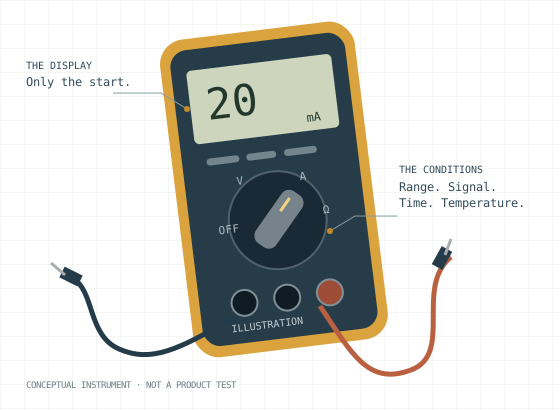
Try the error-limit calculator ↗20 mA
READ THE CLAIM. SEE THE SOURCE.
Evidence should be easy to inspect.
These notes interpret published sources. External measurements stay attributed to their authors. No original instrument test by this publication is included.