Meter & Probe worked guide

Calculate RMS and crest factor for a pulse train

For a 5 V pulse present for only 10% of each period, the mean is 0.50 V while full RMS is about 1.58 V. Choosing the wrong quantity changes the answer before any instrument error is considered.

Content reviewed · Examples are calculations, not tests of a supplied instrument.

A 5 V pulse, off for 90% of the time

Take an ideal signal that is 5 V for 10% of each period and 0 V otherwise. The DC mean is 5 × 0.10 = 0.50 V. Full RMS is √(25 × 0.10) = 1.58 V. Remove the mean to get AC-only RMS: √(1.58² − 0.50²) ≈ 1.50 V. The ideal full-signal crest factor is 5 ÷ 1.58 ≈ 3.16. For the AC component, the positive peak is 4.50 V, so its crest factor is 3.

At 50% duty the same signal would have a 2.50 V mean, a 3.54 V full RMS and a 2.50 V AC-only RMS. You can reproduce either case with VRMS = Vhigh√d for this particular zero-to-high ideal waveform.

At 1% duty, the same ideal 5 V pulse has 0.50 V full RMS and a full-signal crest factor of 10. Low RMS does not imply a low peak, so a range selected from RMS alone can be unsuitable.
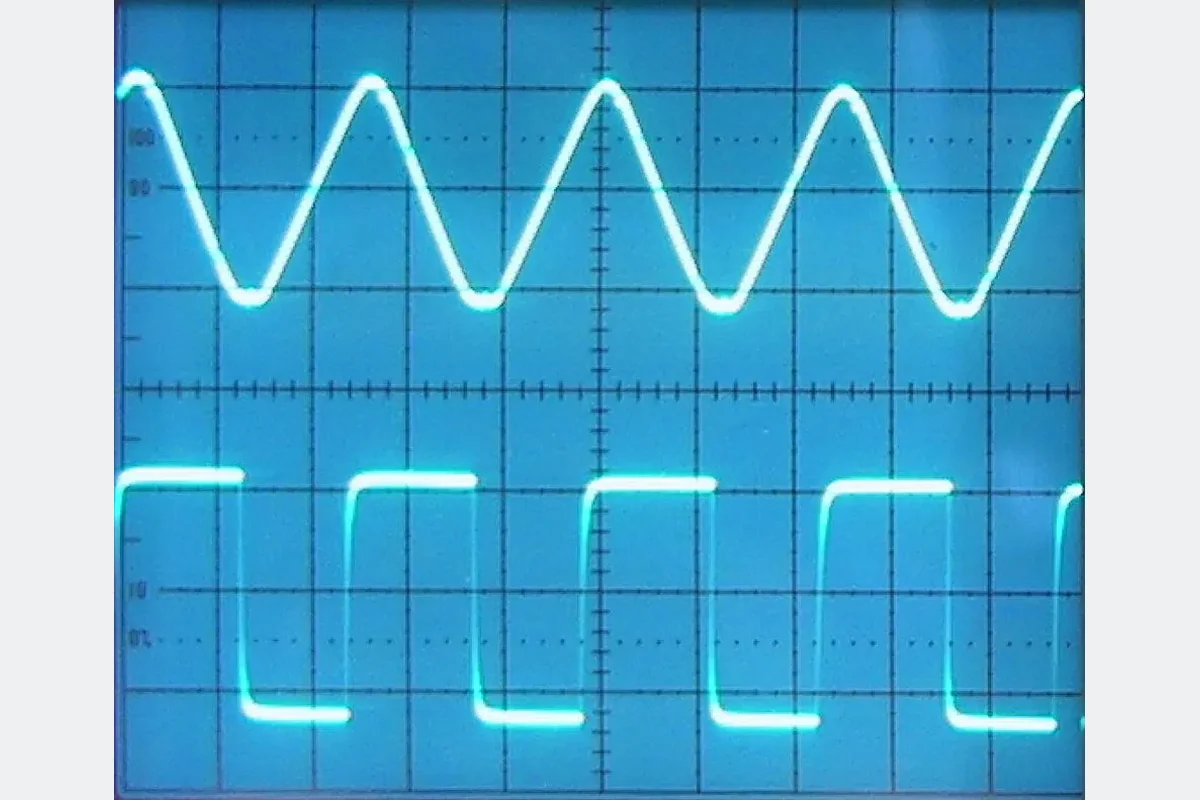
Triangle and square wave traces photographed on a real oscilloscope screen.
Triangle and square wave traces photographed on a real oscilloscope screen.Real photograph · illustrative context, not a Meter & Probe test. User:Xato / Wikimedia Commons · CC0 · resized and letterboxed for web

Compare the expected quantity with the selected function

An AC-coupled meter may reject the DC portion. A combined AC+DC function, if offered, answers a different question. Find the actual range, frequency response and crest-factor conditions. A low repetition rate alone does not guarantee usable response: sharp pulse edges bring higher-frequency components. Check the peak versus the instrument input and what the accuracy table covers.

This is a calculation, not a measured result for a named meter. For a distorted or unknown signal, a suitable independent waveform capture can establish the duty, peaks and DC offset first. Limit bench examples to isolated low-voltage signal sources.

Check whether the meter can answer it

Use the True RMS limitations checklist to match the function and its conditions to the quantity you calculated. Record AC-only or AC+DC alongside any reading.
A digital oscilloscope with its signal display and front panel.
A scope photograph illustrates time and amplitude together. Its display is not evidence for the numerical examples below.Wild Pancake / Wikimedia Commons · CC BY 4.0 · resized for web

Sources and review

Reviewed . Numerical examples are calculations or illustrations.

Free online measurement tools

Free tools for pulse and RMS calculations

Use the free PWM and RMS calculator to compare mean, total RMS and AC-only RMS for a two-level pulse. Check bandwidth and crest-factor restrictions separately before comparing a real meter reading.

No sign-up. No subscription. All eight tools are free to use.

Browse all free multimeter tools →

Practical questions

Questions about pulse RMS and crest factor

How is RMS calculated for an ideal pulse that returns to zero?

For pulse height V and duty fraction D, full RMS is the magnitude of V multiplied by the square root of D.

Link to this answer
How does crest factor change as zero-baseline pulse duty becomes smaller?

For the ideal unipolar pulse, crest factor is 1 divided by the square root of duty fraction. Lower duty creates a larger peak-to-RMS ratio.

Link to this answer
What is the crest factor of an ideal pulse at 10% duty?

For a zero-baseline pulse it is 1/√0.1, approximately 3.16. Check how the instrument defines and limits crest factor for its function.

Link to this answer
Why is the average of a pulse different from its heating-related RMS?

The mean weights voltage directly over time, while RMS weights its square. Different waveform shapes can share a mean but have different RMS values.

Link to this answer
Can equal-RMS waveforms have very different peak voltages?

Yes. RMS alone does not determine peak amplitude or waveform shape. Peak limits must be checked separately when assessing an instrument input.

Link to this answer
How does adding DC offset affect a pulse RMS comparison?

The mean changes, so full RMS changes. The AC-only component excludes that constant mean; specify which quantity the comparison uses.

Link to this answer
Does a 1 kHz pulse train contain only a 1 kHz component?

Its shape includes higher-frequency components. Edge speed and pulse width affect the bandwidth needed to represent the waveform adequately.

Link to this answer
Can a narrow pulse fit a meter RMS range but exceed peak limits?

A modest RMS can coexist with a large peak. Check the selected range’s permitted peak and crest-factor conditions.

Link to this answer
What happens to pulse RMS if duty increases while peak stays fixed?

For an ideal zero-baseline pulse, full RMS rises with the square root of duty. The mean rises directly with duty.

Link to this answer
Which waveform details should accompany a pulse RMS result?

Keep high and low levels, duty, repetition rate, coupling and relevant bandwidth together. Identify whether the value is mean, full RMS or AC-only RMS.

Link to this answer
What RMS does a 12 V pulse at 25% duty have?

For an ideal pulse between 0 V and 12 V, full RMS is 12√0.25 = 6 V. Its mean is 3 V.

Link to this answer
What is AC-only RMS for that 0–12 V, 25% waveform?

Subtract the squared mean from squared full RMS: √(36 − 9) ≈ 5.196 V. This assumes the ideal levels and duty remain steady.

Link to this answer
Does a zero-baseline pulse at 100% duty have zero RMS?

Its total RMS equals its constant high level, while its AC-only component is zero. State which RMS quantity you mean.

Link to this answer
Why is crest factor undefined for a completely zero waveform?

Both peak and RMS are zero, so the ratio is 0/0. Report a zero signal rather than assigning it a meaningful crest factor.

Link to this answer
How do I calculate RMS when a pulse switches between 2 V and 5 V?

Use √(D×5² + (1−D)×2²). The zero-baseline shortcut Vhigh√D does not apply when the low level is non-zero.

Link to this answer
What is RMS for a symmetrical square wave between −5 V and +5 V?

Its total RMS is 5 V because the squared magnitude is always 25 V². At equal durations its mean is zero.

Link to this answer
Can I average the two voltage levels and call that RMS?

No. Average the squared levels with their time weights, then take the square root. Averaging the levels gives the mean instead.

Link to this answer
How do pulse width and repetition period determine duty fraction?

Divide the high-state duration by the complete period. A 100 µs pulse every 1 ms has duty fraction 0.1, or 10%.

Link to this answer
If I enter 10 into a duty-fraction formula, will it mean 10%?

No. A fraction of 10 is outside the 0–1 duty range. Use 0.10 in formulas, or 10 only in an input explicitly labelled percent.

Link to this answer
Does changing frequency alter ideal pulse RMS if duty and levels stay fixed?

Not in the ideal calculation. A real source and instrument can respond differently as frequency changes, so the measured result may change.

Link to this answer
How much power would the ideal 6 V RMS waveform dissipate in 100 Ω?

For an unchanged purely resistive 100 Ω load, P = 6²/100 = 0.36 W. This calculation does not choose a resistor's required rating or thermal design.

Link to this answer
Is crest factor calculated from peak-to-peak voltage?

Normally it uses the peak magnitude of the defined waveform component divided by its RMS. Peak-to-peak is a different quantity and cannot be substituted without conversion.

Link to this answer
Why do full-signal and AC-component crest factors differ on unipolar PWM?

Removing the mean shifts the high and low levels relative to zero. Use the peak and RMS of the same component in each ratio.

Link to this answer
Can I use one period to calculate RMS for irregular radio bursts?

Only if that period represents the intended window. For irregular events, integrate squared voltage over a suitably representative interval and state that interval.

Link to this answer
What should I do with overshoot that the ideal pulse model ignores?

Measure the actual waveform with appropriate bandwidth and safe references. Overshoot can affect peak limits and RMS, so keep the ideal estimate separate from the capture.

Link to this answer
Public discussions behind these questions

These discussions helped identify practical questions. The answers and calculated examples here are our own; technical references are listed in the article. Forum replies can disagree and are not product tests or safety certification.

Questions also include related situations inferred from the article. They are not measured search-frequency data.