Meter & Probe worked guide

What does a multimeter continuity beep actually prove?

A cable can beep and still have too much resistance for its job. The buzzer answers the meter's threshold question, which may be much looser than your connection requirement.

Content reviewed · Examples are calculations, not tests of a supplied instrument.

Read the threshold and the test conditions

Look for the buzzer threshold, how quickly it responds and any band where behaviour is not guaranteed. Some manuals specify separate points for sound and no sound. Keep continuity checks on safe, isolated, de-energised items. A parallel route on an assembled board or stored charge can make a simple path indication misleading.

When checking an unplugged spare low-voltage cable, distinguish a stable indication from a brief beep when the probes touch or move. Record whether the displayed resistance stays stable. Use the same endpoints consistently; do not treat continuity as a substitute for insulation or protective conductor test requirements.

In the illustrative 30 Ω-threshold example, a 12 Ω path beeps but fails a 0.50 Ω requirement. Use the displayed resistance and an appropriate measurement budget when the distinction matters.
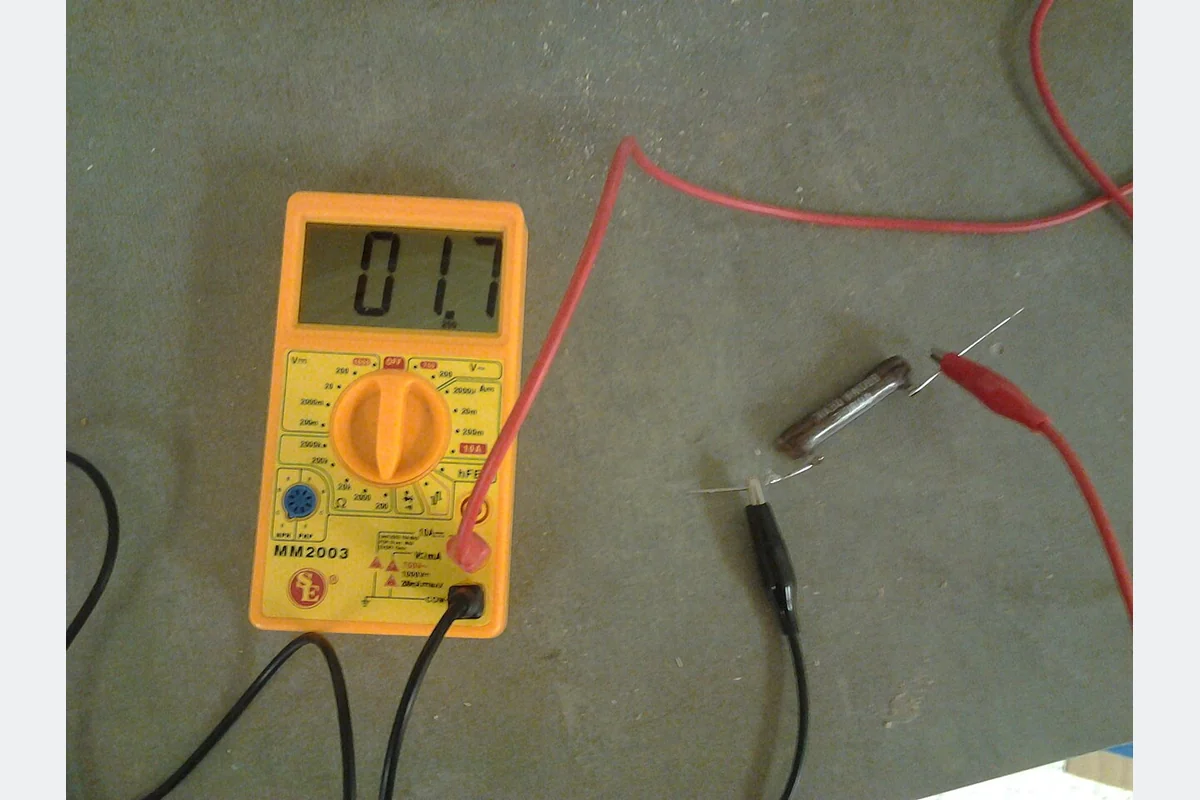
A digital multimeter connected by test leads to a small component during a resistance measurement.
A digital multimeter connected by test leads to a small component during a resistance measurement.Real photograph · illustrative context, not a Meter & Probe test. Kmashaye5220 / Wikimedia Commons · CC BY-SA 3.0 · resized and letterboxed for web

Compare the tool threshold with your requirement

Suppose a meter beeps below 30 Ω and a connection measures 12 Ω. A beep is expected in this illustrative case. If the application needs less than 0.50 Ω, it fails that resistance requirement even though the instrument beeped. A short, intermittent beep at first contact also does not show that the path remained closed.

The example threshold is not a product specification. Use the exact manual if sound is an important part of your workflow.

Choose a more useful reading when the limit is low

For a quantitative low-resistance comparison, follow the lead-offset example and account for the instrument range and repeatability.
A time delay circuit assembled on a breadboard.
Powered circuits are not continuity-test targets. Use a safe, de-energised setup.MikeRun / Wikimedia Commons · CC BY-SA 4.0 · resized for web

Sources and review

Reviewed . Numerical examples are calculations or illustrations.

Common questions

Is the continuity buzzer enough, or do I need a low-resistance meter?

A buzzer can answer whether the model-specific threshold was crossed. If you need a small numerical resistance value, compare the expected resistance with the lead offset and uncertainty.

Free online measurement tools

Free tools for continuity readings

Use the free multimeter reading checker for a silent or unexpected buzzer. A continuity beep and a low-resistance measurement answer different questions, so keep the actual threshold in view.

No sign-up. No subscription. All eight tools are free to use.

Browse all free multimeter tools →

Practical questions

Questions about continuity thresholds and response

What resistance makes a multimeter continuity buzzer sound?

The threshold is instrument-specific and can include stated qualifications. Find the exact function specification rather than assuming one universal resistance value.

Link to this answer
Why do two multimeters beep at different resistances?

Their thresholds, test methods and response characteristics can differ. A sound comparison is not the same as comparing calibrated resistance indications.

Link to this answer
Can a continuity buzzer miss a very brief interruption?

Response time and latching behaviour affect short events. Check the manual and use a suitable time-resolved method if the interruption duration matters.

Link to this answer
Why might a capacitor cause a momentary continuity beep?

The test response can change as the component charges from the meter’s stimulus. A transient sound does not establish a permanent short circuit.

Link to this answer
Does a beep establish that a connection will carry its operating current?

The continuity stimulus is not the service load. A connection can behave differently under the actual current and mechanical conditions.

Link to this answer
Why should I read the ohms indication as well as listening?

A beep compresses the response into a threshold decision. The numerical value and its stability provide more context for interpreting the path.

Link to this answer
Can diode conduction trigger a continuity indication in one polarity?

Depending on the meter and circuit, semiconductor conduction can affect the response. Diode mode and continuity use different criteria.

Link to this answer
Does no beep distinguish an open wire from poor probe contact?

Not by itself. Probe contact, range or mode selection and the circuit path can produce similar indications. Establish a repeatable defined check.

Link to this answer
Is a powered circuit suitable for an ordinary continuity check?

Continuity and resistance checks belong to an appropriately isolated and discharged setup, following the instrument and equipment instructions.

Link to this answer
What should I note when an intermittent cable passes a beep test?

Keep the numeric indication, contact arrangement, movement conditions and test response limits. A brief threshold test may not reproduce the operating fault.

Link to this answer
Why does my 10 Ω resistor beep when I expected only a short circuit to beep?

Many continuity thresholds include resistances well above zero. The sound means the instrument's criterion was met, not that the resistance is exactly zero.

Link to this answer
How do I select the buzzer when it shares a dial position with diode mode?

Use the function-selection button specified in the manual and confirm the display symbol. Turning to the shared position may select a different function initially.

Link to this answer
Can a resistance range work even when the continuity buzzer is silent?

Yes. A valid resistance can lie above the buzzer's threshold, or the audible function may not be selected. Check the numeric value and mode.

Link to this answer
Why does a continuity reading change when I flex an unplugged cable?

An intermittent contact or conductor may respond to movement. Keep the endpoints fixed and observe the resistance; do not infer the exact fault location from sound alone.

Link to this answer
Does a beep between two PCB pads prove they are on the same copper net?

Other paths can conduct between the pads. Compare with the schematic and check the unpowered network before treating the beep as a net identification.

Link to this answer
Why does the buzzer stay on briefly after the probes separate?

Some instruments latch or extend an audible event so it can be heard. The duration of the sound is not necessarily the duration of electrical contact.

Link to this answer
Is an intermittent beep enough to grade a relay contact?

No. Contact behaviour depends on the test conditions and service load. A threshold check cannot replace the specified contact-resistance or functional test.

Link to this answer
Can a long cable beep more slowly than touching the probe tips?

Cable capacitance and instrument response can affect the result. Compare the numeric settling behaviour and check whether the method suits that cable.

Link to this answer
Why do I hear a beep through an inductor or transformer winding?

An intact winding can have low DC resistance. Continuity does not establish its inductance, insulation condition or behaviour at operating frequency.

Link to this answer
Can I use continuity mode to decide whether a capacitor is healthy?

A charging transient can create a brief response, but it does not measure capacitance, leakage or ESR adequately. Use the relevant component test.

Link to this answer
Does a beep across a low-voltage motor mean its winding is shorted?

A winding normally has a conductive path. Its acceptable resistance and other tests depend on the motor; a beep alone does not diagnose a winding fault.

Link to this answer
What if one polarity beeps and the reverse polarity stays silent?

Semiconductors or other network paths may be involved. Compare diode-mode readings on the appropriately unpowered setup rather than calling it an intermittent wire.

Link to this answer
Will buying a louder buzzer improve low-resistance measurement accuracy?

Loudness helps audibility, not numerical accuracy. Check threshold, response time, resolution and lead effects according to the task you need to perform.

Link to this answer
How can I check whether the sound is disabled rather than the path open?

Use the documented sound setting and a defined probe-tip check away from a circuit. Compare the display response before judging the item under test.

Link to this answer
What details help explain “it beeps but the device still fails”?

Give the selected mode, numeric resistance, exact endpoints, movement and operating symptom. The service current or a parallel path may explain why the beep was insufficient.

Link to this answer
Public discussions behind these questions

These discussions helped identify practical questions. The answers and calculated examples here are our own; technical references are listed in the article. Forum replies can disagree and are not product tests or safety certification.

Questions also include related situations inferred from the article. They are not measured search-frequency data.