Meter & Probe worked guide

Read the UNI-T UT139C specification for a 12 V check

At 12.00 V, the UT139C example uses the 60.00 V DC range. Its 0.01 V display step and ±(0.7% + 3 digits) line give a ±0.114 V specification limit under the cited conditions.

Content reviewed · Examples are calculations, not tests of a supplied instrument.

Identify the row and the active range

UNI-T lists the UT139C as a 6000-count meter. The UT139A/B/C manual gives a 60.00 V DC range for the C model and a 0.01 V resolution there. The range table gives ±(0.7% of reading + 3 digits) at the stated reference conditions (23 °C ±5 °C and below 75% RH). The tighter ±(0.5% + 2 digits) line in that table applies to the millivolt ranges and should not be used for 12 V. Check the manual for the exact version in hand.

Comparing 12.00 V with a target of 12.00 V hides the useful question: how much deviation is allowed? A ±0.05 V requirement is narrower than the example's ±0.114 V instrument limit, before source stability or loading is considered.
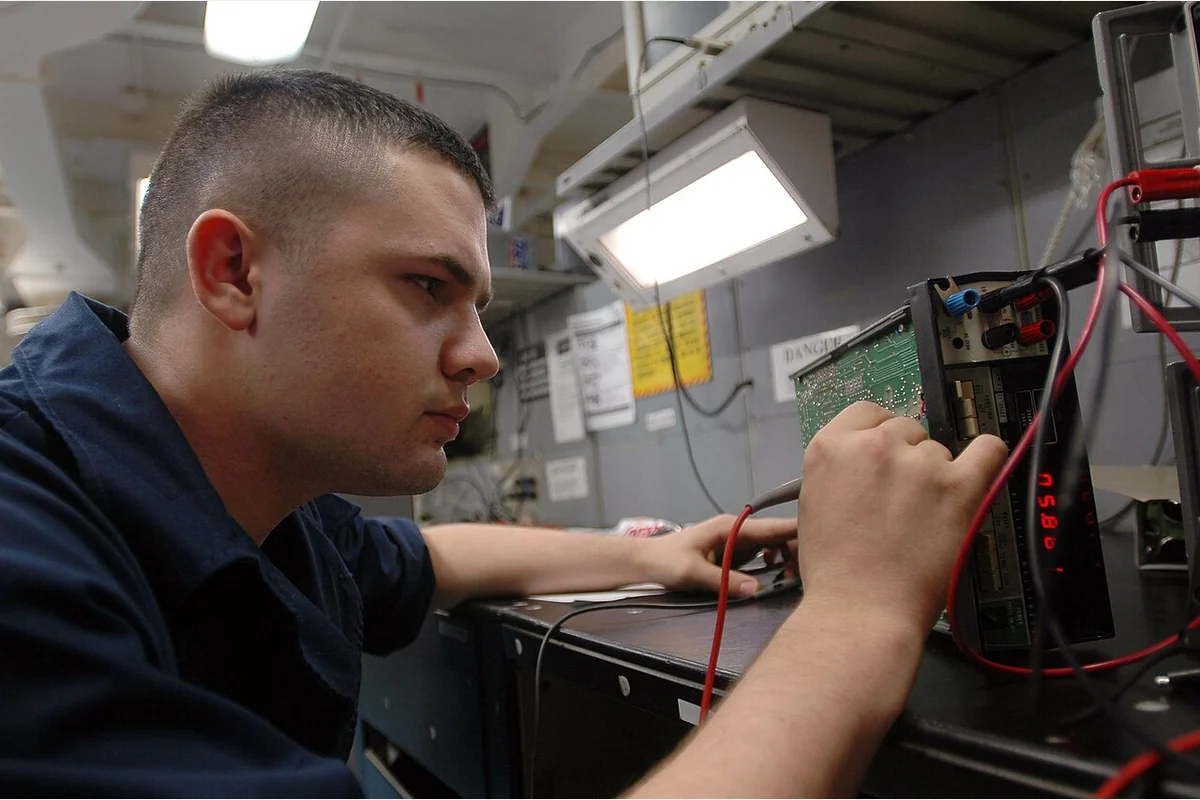
A US Navy electronics technician troubleshooting a circuit board with a digital multimeter.
A US Navy electronics technician troubleshooting a circuit board with a digital multimeter.Real photograph · illustrative context, not a Meter & Probe test. U.S. Navy photo by Mass Communication Specialist 3rd Class Jason A. Johnston / Wikimedia Commons · Public domain · resized and letterboxed for web

Work a 12.00 V example

0.007 × 12.00 V = 0.084 V. Three digits on that range contribute another 0.030 V. The specification-only error limit is therefore ±0.114 V, or an interval of 11.886 to 12.114 V around 12.00 V. It would not alone resolve a requirement tighter than that around the indicated value. The 0.01 V step describes the display.

Identify effects the limit does not include for your measurement, such as source loading, ripple, lead contact and operation outside the specified environmental conditions. This is a calculation for a steady isolated bench voltage, not a measured check of a shipped sample or evidence of suitability for an installation task.

Take the next step only if the budget fits

Compare the result with the actual tolerance. If a lead-based multimeter fits, use the free selector below to reach the UT139C listing. Check the exact manual and supplied set before buying.

Compare the instrument for this task

Open the free selector with this method. It uses published listing and instrument information.
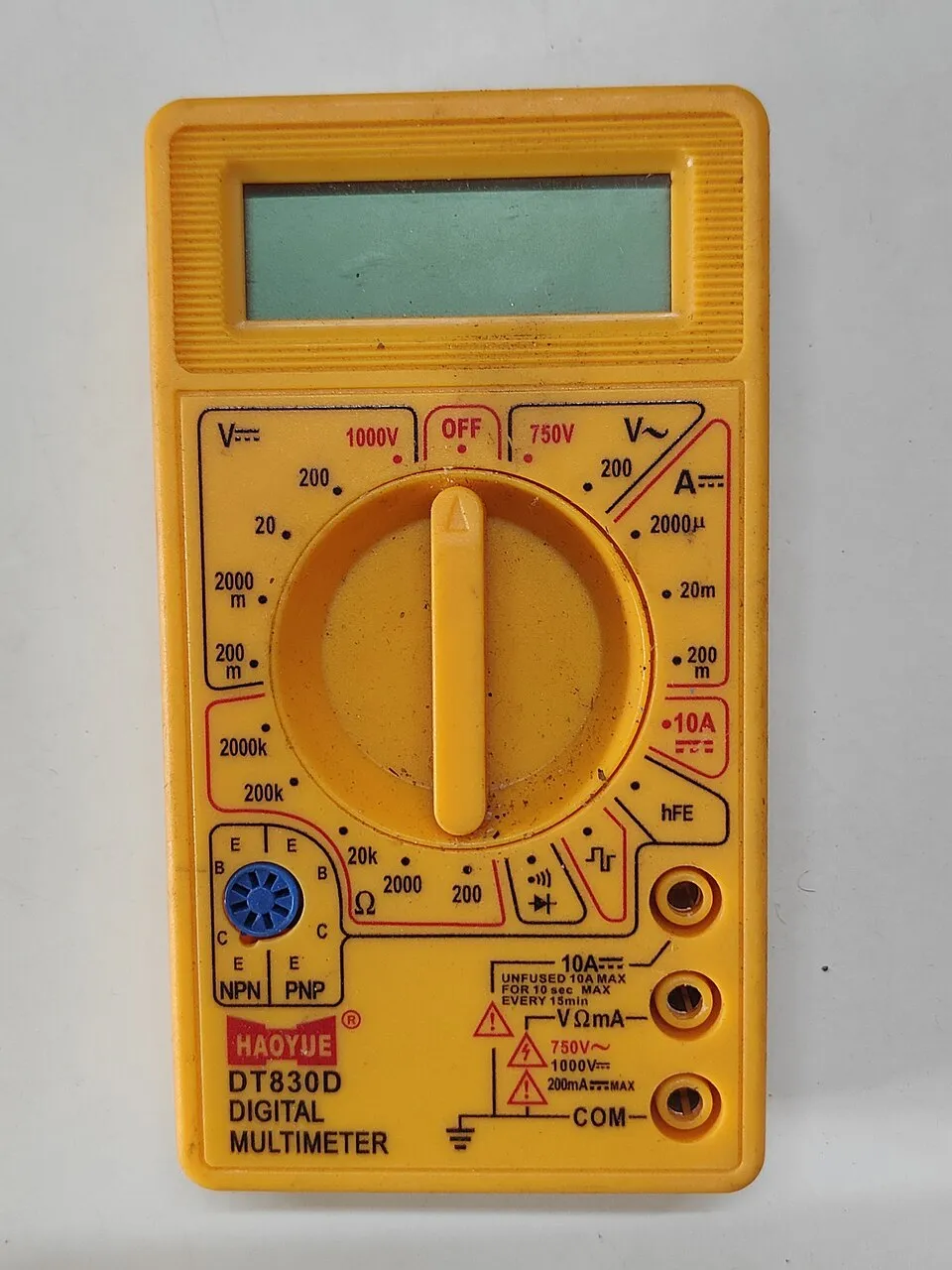
A handheld meter with the dial, display and connections visible.
Example meter dial; use the UT139C manual for the actual range.Ranjithkumar Murugesan / Wikimedia Commons · CC0 · resized for web

Sources and review

Reviewed . Numerical examples are calculations or illustrations.

Common questions

Can a UNI-T UT139C tell whether my 12 V bench supply is within spec?

Compare the full interval on the UT139C’s actual DC voltage range with the supply tolerance. A display inside the limit is not enough when its error interval crosses the boundary.

Free online measurement tools

Free tools for the UT139C voltage example

Use the free multimeter accuracy calculator with the complete range specification. The reading-comparison tool can then help assess a change under matching conditions; buying a product is not required.

No sign-up. No subscription. All eight tools are free to use.

Browse all free multimeter tools →

Practical questions

Questions about reading the UT139C DC voltage table

Which UT139C range specification is relevant to a 12 V bench reading?

The cited manual uses the C model’s 60.00 V DC range, with a 0.01 V step, for this example. Check the exact manual version.

Link to this answer
Why should I not use the UT139C millivolt accuracy line for 12 V?

The tighter millivolt-range line applies to different ranges. The worked 12 V example uses the applicable 60.00 V DC row instead.

Link to this answer
How does the UT139C 3-digit term become 0.030 V on the example range?

Each last-place step is 0.01 V, so three steps contribute 0.03 V. That count contribution is added to the percentage term.

Link to this answer
What specification-only limit does the cited UT139C table give at 12.00 V?

Using 0.7% of 12.00 V plus three 0.01 V steps gives ±0.114 V. The example interval is 11.886 V to 12.114 V.

Link to this answer
Does a UT139C display of 12.00 V establish a 0.01 V accuracy?

The 0.01 V step is resolution. The applicable percent-plus-counts limit is wider, and additional measurement effects may need separate assessment.

Link to this answer
Which environmental conditions accompany the cited UT139C example?

The note cites reference conditions of 23 °C ±5 °C and below 75% relative humidity. Confirm conditions and qualifications in the manual for the version used.

Link to this answer
Does the UT139C worked example show a test of a delivered retail unit?

It is specification arithmetic for an isolated steady bench voltage. It does not document a measured comparison of a shipped sample.

Link to this answer
What should I consider if my 12 V tolerance is tighter than ±0.114 V?

The cited specification alone does not resolve a tighter requirement around that indication. Reassess the method, range and total measurement budget.

Link to this answer
Can input loading or ripple add uncertainty beyond the UT139C table calculation?

Yes. The note identifies loading, ripple, contacts and operation outside stated conditions as effects that the specification-only example does not settle.

Link to this answer
Where should I verify the UT139C accessory set before ordering?

Check the exact current seller listing and manufacturer instructions. This worked specification note does not establish the accessory set supplied with an order.

Link to this answer
How much of the UT139C 12 V example comes from the percentage term?

At 12.00 V, 0.7% contributes 0.084 V. Add 0.030 V from three 0.01 V steps to obtain the illustrated ±0.114 V limit.

Link to this answer
What are the endpoints around the example UT139C indication of 12.00 V?

Subtract and add 0.114 V to get 11.886–12.114 V. Those endpoints come from the stated terms, not a calibration of a particular unit.

Link to this answer
What does the same cited line give at an indicated 24.00 V?

If that range and all cited conditions apply, 0.7% of 24 V is 0.168 V; adding 0.030 V gives ±0.198 V.

Link to this answer
Can I use this DC example for a 12 V AC transformer output?

No. AC voltage has a different function specification and waveform conditions. Also establish whether the source is safely isolated before choosing a method.

Link to this answer
Does a 12 V battery label guarantee the meter should read exactly 12.00 V?

No. The label is nominal. Chemistry, charge state and load affect terminal voltage, so a nominal label is not a reference voltage.

Link to this answer
Will relative mode make the UT139C meet a tighter absolute voltage requirement?

Subtracting a baseline changes the displayed reference. It does not by itself establish a smaller absolute error or remove drift and loading.

Link to this answer
Can I compare an unloaded supply setting with a loaded meter reading?

The supply may change under load. Compare the same terminals and load state; otherwise a source change becomes mixed with meter error.

Link to this answer
What if my UT139C manual gives a different revision of the table?

Use the document that applies to your exact instrument. Keep its revision and conditions with the calculation rather than forcing it to match this example.

Link to this answer
Why should I note the displayed range even when autorange selects it?

The range determines both the last-digit step and the applicable row. A screenshot of the number without its unit and range can leave the calculation ambiguous.

Link to this answer
Does the guide's 0.114 V result include probe contact problems?

No. It applies the cited percentage and digit terms only. Unstable contact, loading and a changing source need separate assessment.

Link to this answer
Can the UT139C worked example diagnose a faulty regulator at 11.95 V?

Not alone. Compare the regulator's allowed limits and operating conditions with the entire measurement interval, then include relevant setup effects.

Link to this answer
Should I adjust a supply until this meter displays more decimal places?

Changing the source does not add instrument resolution. Choose the required voltage and suitable measurement method; do not tune around display formatting.

Link to this answer
Can I reuse the DC voltage specification for diode or continuity mode?

No. Those modes apply their own stimulus and criteria. The DC voltage error line does not describe diode-test current or buzzer response.

Link to this answer
What should I ask a seller if the listing only says 6000 counts?

Ask for the exact manufacturer manual, model and relevant range specification. Also confirm the supplied leads and required functions before comparing the price.

Link to this answer
Is an online product photograph evidence of the delivered meter's calibration?

No. It identifies the marketed product at most. Calibration requires a record tied to the particular instrument and the measurements performed.

Link to this answer
Public discussions behind these questions

These discussions helped identify practical questions. The answers and calculated examples here are our own; technical references are listed in the article. Forum replies can disagree and are not product tests or safety certification.

Questions also include related situations inferred from the article. They are not measured search-frequency data.