Meter & Probe worked guide

Check DC clamp zero before and after a small reading

A clamp baseline that moves from +2 mA to +8 mA can overshadow a small load change. Take no-current observations before and after, with the same range and orientation, before interpreting the last digit.

Content reviewed · Examples are calculations, not tests of a supplied instrument.

Keep the setup and orientation fixed

Read the zeroing procedure for the instrument. With no conductor inside closed jaws and in the measurement orientation, log the displayed reading before using the maker’s zero or relative function. Use the same range and jaw orientation, and note nearby current-carrying conductors or magnetic fields. Without pressing zero again, record a corresponding no-conductor reading afterwards.

Only compare with a safely accessible single conductor in a known isolated low-voltage setup. Do not move or split installed wiring to make a measurement. Note whether switching ranges or changing orientation breaks the comparison.

If the loaded indication is 22 mA, subtracting those two baselines suggests 20 mA or 14 mA. The spread exposes the problem; taking their average does not prove what the baseline was during the measurement.
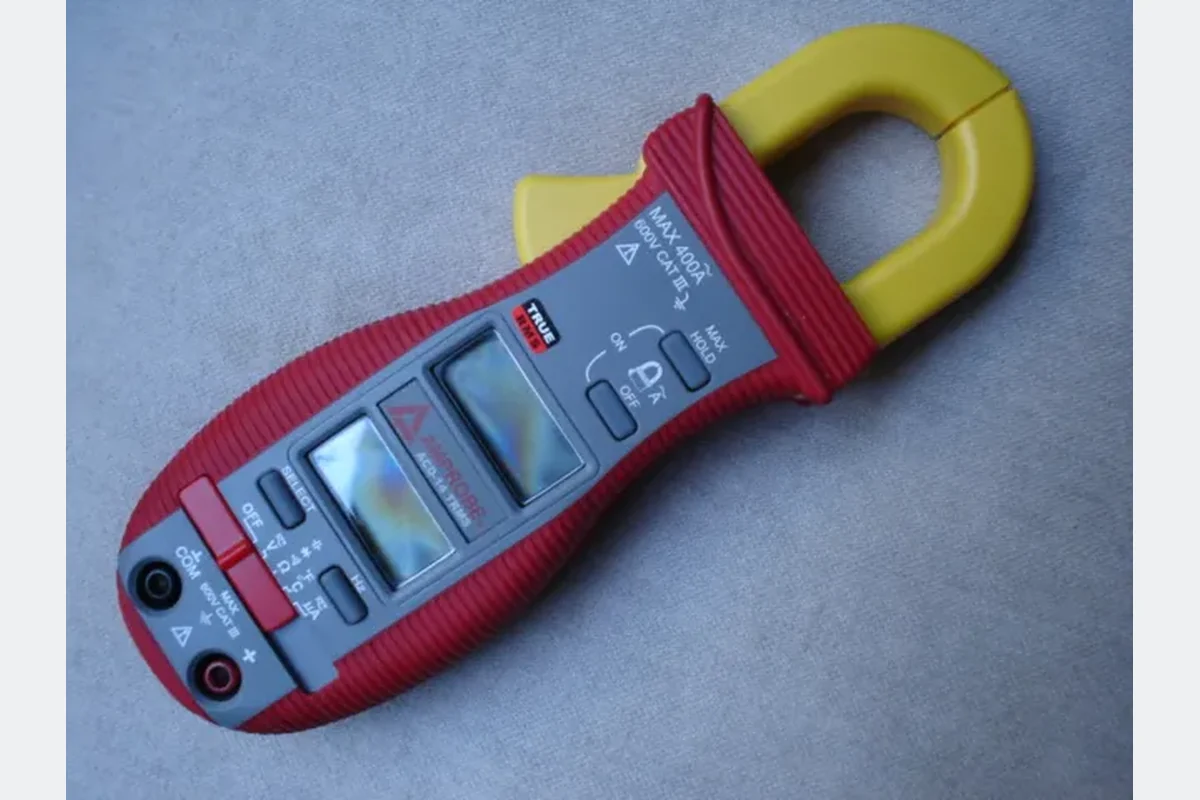
A red handheld clamp meter with a yellow split jaw and its rotary selector visible.
A red handheld clamp meter with a yellow split jaw and its rotary selector visible.Real photograph · illustrative context, not a Meter & Probe test. E dog95 at English Wikipedia / Wikimedia Commons · CC BY-SA 3.0 · resized and letterboxed for web

Worked before-and-after check

Imagine the baseline is +2 mA before the reading, the indication is +22 mA and the baseline is +8 mA afterwards. Simply subtracting those two baselines from the indication gives 20 mA or 14 mA. That six-milliamp spread can matter more than the last display digit. It is not a confidence interval because drift during the measurement is unknown, and range error still applies.

If the decision depends on a 2 mA difference, this example cannot support it. Repeat the setup or use a method with an error budget that fits the task. Do not average away unrelated changes in the load.

Compare the result with the full budget

Use the low-current clamp limitations guide to add range error and resolution. Pick an independent method when the repeat evidence is too weak for the decision.
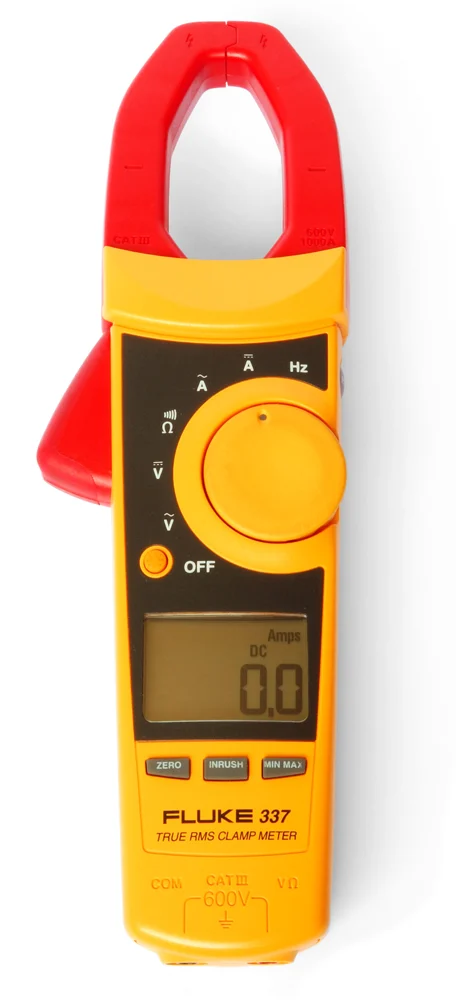
A Fluke 337 clamp meter with its jaw, selector and display visible.
A Fluke 337 clamp meter with its jaw, selector and display visible.Archive photograph; not a Meter & Probe hardware test. Harke / Wikimedia Commons · Public domain · Resized; converted to WebP.

Sources and review

Reviewed . Numerical examples are calculations or illustrations.

Free online measurement tools

Free tools for a drifting DC clamp baseline

Use the free clamp calculator with the observed drift magnitude and the actual display step. The comparison tool can put repeated readings in context, but it does not make a drifting zero disappear.

No sign-up. No subscription. All eight tools are free to use.

Browse all free multimeter tools →

Practical questions

Questions about DC clamp baseline stability

Why does a DC clamp zero change even when no conductor is in the jaws?

The baseline can depend on temperature, magnetic conditions and instrument state. Record its behaviour instead of assuming one zero applies indefinitely.

Link to this answer
Can moving or rotating a DC clamp change its empty-jaw indication?

The magnetic environment and orientation can affect a sensitive baseline. Keep the arrangement consistent when assessing a small signal.

Link to this answer
Why should I compare zero observations before and after a small-current check?

A changing baseline can account for part of the apparent signal. Bracketing observations help show whether one offset is representative.

Link to this answer
Does pressing the clamp zero button verify the resulting current accuracy?

The control adjusts the displayed baseline under its conditions. It does not remove the full range limit or verify a small-current measurement against a reference.

Link to this answer
Can I subtract yesterday’s clamp offset from today’s reading?

Only if the relevant baseline remains applicable, which should be demonstrated. Different temperature, orientation or instrument state can make an old value unsuitable.

Link to this answer
What does a negative empty-jaw current tell me?

It shows the signed baseline under that setup. It is not evidence of a physical reverse current without a defined current path.

Link to this answer
How do jaw closure and repeat positioning affect a zero-drift check?

Mechanical and placement conditions can influence repeatability. Follow the exact instrument instructions and keep those conditions with the observations.

Link to this answer
Will increasing the number of displayed decimal places stabilise a drifting clamp?

A finer indication does not stabilise the underlying baseline. Compare the drift with the actual signal and required decision.

Link to this answer
How can I distinguish a current change from baseline movement?

Use comparable geometry and repeated baseline observations around the measurement. A single before-and-after number cannot separate the two effects by itself.

Link to this answer
When is clamp drift too large for the small-current decision?

When its variation is comparable to the change you need to distinguish, the method may be insufficient. Assess the full budget rather than choosing a universal threshold.

Link to this answer
Should I zero a DC clamp with the conductor already inside?

Follow the exact manual. Zeroing with load current present can remove that signal from the display, leaving a relative change rather than the original absolute current.

Link to this answer
Why does opening and closing the jaws change the empty reading?

Closure and magnetic conditions can change. Repeat the maker's specified preparation and assess baseline repeatability before relying on a small indication.

Link to this answer
Can a speck of dirt in the jaw gap affect the result?

An obstruction can prevent proper closure. Inspect and maintain the jaws according to the manual rather than forcing them shut or altering their surfaces.

Link to this answer
Should I press zero again before recording the post-measurement baseline?

If the purpose is to observe drift, first record the baseline without re-zeroing. Otherwise the action hides the very movement you are trying to assess.

Link to this answer
Why is averaging the before and after zeros not a guaranteed correction?

The baseline may not have moved linearly or smoothly during the test. An average is an assumption, not a measured drift history.

Link to this answer
Can a clamp zero change while the display is held?

The hold function freezes the visible number, not the sensor's physical conditions. Release hold and perform the required checks to observe the current baseline.

Link to this answer
How long should I wait for a clamp to settle?

Use the instrument's instructions and observe repeatability for the task. There is no universal waiting time that establishes accuracy for every model and environment.

Link to this answer
Does warming the clamp in my hand matter for tiny current readings?

Temperature changes can affect baseline behaviour. Keep handling and ambient conditions comparable, and include observed drift in the decision.

Link to this answer
Can changing the battery in the clamp alter its baseline check?

The preparation and operating conditions may change. Repeat the documented setup and zero checks; a fresh battery does not establish calibration.

Link to this answer
What if I cannot remove the conductor safely for the after-zero check?

Do not alter unsafe or installed wiring to force the procedure. Use a suitable method and access arrangement, or accept that the proposed drift check cannot be completed there.

Link to this answer
Should a negative baseline be clipped to zero in my notes?

No. Keep its sign and magnitude. Replacing it with zero discards information needed to understand small positive or negative readings.

Link to this answer
Can drift explain a reported reversal from +2 mA to −2 mA?

It may when the signal is comparable to baseline movement. Check the no-current response and conductor direction before claiming the physical current reversed.

Link to this answer
Why should a nearby power supply stay in the same position during a clamp check?

Nearby magnetic fields and geometry can affect the sensor. Moving equipment between observations changes the conditions of the comparison.

Link to this answer
Can I quote the baseline spread as a 95% uncertainty?

Not without a justified statistical and measurement model. A few before-and-after values do not automatically define a confidence interval.

Link to this answer
When is another current method more useful than repeated re-zeroing?

When baseline movement remains comparable to the change you need to judge. Re-zeroing cannot recover information the complete method cannot resolve reliably.

Link to this answer
Public discussions behind these questions

These discussions helped identify practical questions. The answers and calculated examples here are our own; technical references are listed in the article. Forum replies can disagree and are not product tests or safety certification.

Questions also include related situations inferred from the article. They are not measured search-frequency data.