Meter & Probe worked guide

Does the meter reading prove it is within tolerance?

An indication of 5.080 V sits inside a 4.900–5.100 V band. In the worked example, its instrument interval reaches 5.1074 V, so the display alone cannot settle the pass decision.

Content reviewed · Examples are calculations, not tests of a supplied instrument.

Write down the two limits first

Suppose a bench supply must be between 4.900 V and 5.100 V. The active meter range reads to 0.001 V and is specified, for the assumed conditions, at ±(0.5% of reading + 2 digits). Apply both terms to the indicated value. One digit here is one 0.001 V step. These numbers describe an example instrument range.

At 5.080 V, the error limit from those terms is 0.0254 + 0.002 = 0.0274 V. The resulting interval is 5.0526 to 5.1074 V. The display is inside the allowed band, but the interval overlaps the 5.100 V limit. Treat that result as inconclusive under the stated assumptions.

Write “indication inside band; interval crosses upper limit” when that is what the calculation shows. Rounding 5.080 V to “5.1 V, pass” would discard the evidence needed to decide whether a better measurement is worthwhile.
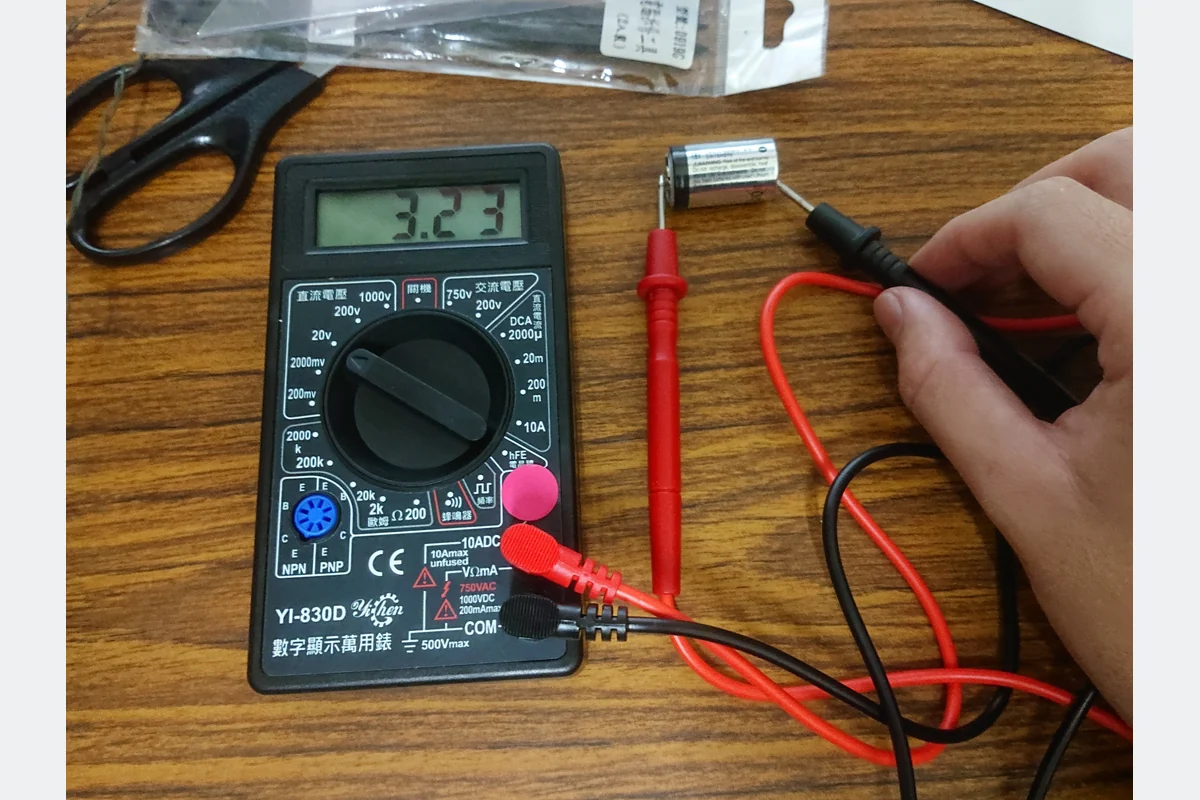
A person holding multimeter probes against a small battery while a digital meter displays its voltage.
A person holding multimeter probes against a small battery while a digital meter displays its voltage.Real photograph · illustrative context, not a Meter & Probe test. Jiazheng0609 / Wikimedia Commons · CC BY-SA 4.0 · resized and letterboxed for web

Distinguish all three decisions

Entire interval fits
5.020 V gives a 4.9929–5.0471 V interval. On this simple error budget it supports acceptance.
Interval touches or crosses a limit
Use a more suitable range or a better reference before making the decision.
Entire interval is outside
5.150 V gives 5.12225–5.17775 V, wholly above the allowed band under the assumed conditions.

These are instrument specification limits, not a statistical uncertainty estimate or a calibrated test. Add relevant setup effects such as input loading, reference uncertainty, temperature and drift under your procedure.

Calculate your range contribution

Use the percent-and-digits calculator with the actual displayed range. If the instrument’s conditions do not apply to the signal, do not use the interval to make an acceptance statement.
A real bench setup featuring a diode, battery and meter.
A diode and meter in an illustrative circuit. This photograph is not the isolated, unpowered test described below.Cyril Mechkov -- Circuit-fantasist / Wikimedia Commons · CC BY-SA 4.0 · resized for web

Sources and review

Reviewed . Numerical examples are calculations or illustrations.

Common questions

What should I do when the reading is in tolerance but its interval crosses the limit?

The unloaded reading only shows the voltage under light load. Check the device manual for an appropriate load test or known-good source before changing the meter.

Free online measurement tools

Free tools for checking a reading against tolerance

Use the free multimeter accuracy calculator to find the full instrument interval. The comparison tool helps assess changes between readings; a displayed value inside a tolerance band is not enough by itself.

No sign-up. No subscription. All eight tools are free to use.

Browse all free multimeter tools →

Practical questions

Questions about deciding whether a reading meets tolerance

Is a displayed value inside tolerance enough to accept a component?

Consider the instrument’s error interval as well as the indication. A number inside the allowed band can still have an interval extending beyond it.

Link to this answer
What does it mean if the whole meter interval fits inside my allowed limits?

Under the stated model, the specification interval supports a stronger decision than the indication alone. Other relevant measurement contributions still need consideration.

Link to this answer
How should I handle a reading whose uncertainty interval crosses a tolerance boundary?

Treat the decision as unresolved under that budget. Improve the measurement or apply the appropriate documented decision rule for the task.

Link to this answer
What is the difference between product tolerance and multimeter accuracy?

Product tolerance defines the allowed characteristic. Meter accuracy limits concern the measurement indication; the two quantities play different roles in an acceptance decision.

Link to this answer
Can I use a nominal supply setting as the true comparison value?

A nominal setting is not automatically a reference measurement. Keep its actual behaviour and any reference uncertainty separate from the meter indication.

Link to this answer
Why does a tolerance check near the boundary need more care?

A small measurement contribution can change which side of the limit remains plausible. Record the complete interval rather than rounding the indication into a pass.

Link to this answer
Does averaging repeated indications remove the meter specification limit?

Averaging may reduce some random variation. It does not automatically remove offset, calibration, loading or other systematic contributions.

Link to this answer
How do I compare a plus-or-minus voltage tolerance with a meter interval?

Express both as lower and upper bounds in the same unit. Check whether the complete modelled measurement interval lies within the allowed bounds.

Link to this answer
Can a reading outside tolerance prove that the device is faulty?

Check the measurement method and its limits first. An indication alone does not identify whether the device, reference, loading or setup caused the discrepancy.

Link to this answer
What should I record when the tolerance decision remains inconclusive?

Keep the indication, active range, specification, allowed limits, conditions and the reason the interval overlaps a boundary. Identify the next discriminating measurement.

Link to this answer
How do I turn a 5 V ±2% requirement into limits?

Two percent of the nominal 5 V is 0.100 V, so the allowed band is 4.900–5.100 V. Apply the product tolerance to its stated base.

Link to this answer
Do I apply product tolerance to the nominal value or my meter indication?

Use the requirement's definition. A tolerance around a nominal value does not move to follow your reading; the instrument error calculation is a separate step.

Link to this answer
Is a meter error limit the same as a component's manufacturing tolerance?

No. One describes the measurement indication under stated conditions; the other describes an allowed product characteristic. Keep them as separate bands.

Link to this answer
What if the entire calculated interval is above the allowed band?

Under that model the result supports rejection. Check that the specification, operating state and other relevant contributions are valid before making the final decision.

Link to this answer
Can an interval that just touches the limit be called a clear pass?

That depends on the stated decision rule and whether the boundary is inclusive. Do not invent a guard band or silently treat contact as a comfortable margin.

Link to this answer
What is a guard band in a tolerance decision?

It narrows an acceptance region to account for measurement risk under an agreed procedure. Its size and rule need justification; it is not simply another name for meter accuracy.

Link to this answer
Will selecting a finer range always change an inconclusive result into a pass?

It may reduce a digits contribution, but percentage terms, noise and other effects remain. Recalculate using the new range rather than assuming improvement is enough.

Link to this answer
Can I subtract an error found at one voltage from every later reading?

A single-point correction needs a justified scope and uncertainty. It does not establish the error at other values, ranges, temperatures or times.

Link to this answer
What should I do if the reference supply also has a tolerance?

Include the relevant reference behaviour or uncertainty in the comparison. Treating a nominal supply setting as exact can make the acceptance claim too strong.

Link to this answer
Does a positive reading error mean the component itself is high?

Only if you have established that error against a suitable reference. A manufacturer's symmetric error limit does not tell you which direction the actual error takes.

Link to this answer
How should I report a result when no decision rule was agreed?

Report the indication, modelled interval, limits and overlap plainly. Avoid converting an unresolved comparison into a formal conformity statement.

Link to this answer
Can I use percent difference from nominal as the whole acceptance check?

It shows the indication's deviation, but omits the measurement limit. Compare the full interval if that is what your decision requires.

Link to this answer
Why can changing load state invalidate a voltage tolerance comparison?

A supply can meet its limit at idle and sag during startup. The requirement and measurement must refer to the same operating state.

Link to this answer
Should I display more decimal places in the pass-fail table?

Extra formatting cannot improve the measurement. Keep enough digits to show the calculation while reporting precision consistent with the instrument and budget.

Link to this answer
How do I ask ChatGPT about a borderline tolerance result?

Provide nominal value, allowed band, indication, active range, full accuracy line and conditions. Ask whether the interval fits, crosses or sits outside the limits.

Link to this answer
Public discussions behind these questions

These discussions helped identify practical questions. The answers and calculated examples here are our own; technical references are listed in the article. Forum replies can disagree and are not product tests or safety certification.

Questions also include related situations inferred from the article. They are not measured search-frequency data.