Two multimeters show different readings: which one should you trust?
One meter says 3.30 V and the other 3.32 V. That difference is worth checking, but it does not identify a winner. Start by making the source, test points and active ranges comparable.
Content reviewed · Examples are calculations, not tests of a supplied instrument.
First make the two measurements comparable: same points, function, source state and timing. Then calculate a limit interval using each meter’s own active-range specification. Overlapping intervals can explain a disagreement within the stated limits; they cannot tell you which meter is correct.
Check that the meters are measuring the same thing
Start with a steady, isolated low-voltage source. Write down DC or AC, the measurement points, units and range. A 3.30 V reading and 3300 mV are the same number. An AC reading and a DC reading can legitimately differ on a signal containing both.
Make the source repeatable. A battery-powered device can draw different current during sleep, startup and radio activity. Measuring those states in sequence is not a controlled meter comparison. Probe pressure, a different ground point, a loose connector or auto-ranging can also change what you see.
Voltage meters connect across two points. Current meters normally connect in series. Do not put a current input across a voltage source, and switch the source off before changing current wiring.
In the worked example, the two intervals overlap despite a 0.02 V difference. Averaging the displays to 3.31 V would make a tidy number, but would not establish a reference voltage.
Use the specification for each active range
A handheld meter may state accuracy as ±(% of reading + counts). For that form, multiply the reading by the percentage and add the counts multiplied by the last display step. Other instruments specify a percentage or parts per million of range as well as reading. Use the maker’s actual formula; do not translate every specification into counts.
Record any temperature, frequency, calibration interval and warm-up conditions that apply. Display resolution tells you the size of the last step, not the total permitted error. A comparison made outside the stated conditions needs more information before a numerical limit can be trusted.
Worked example: 3.30 V versus 3.32 V
These are invented specifications for a calculation, not results from two named products. Assume both meters meet their respective conditions and measure the same steady DC points.
Illustrative active-range limits
Item
Meter A
Meter B
Displayed reading
3.30 V
3.32 V
Assumed specification
±(0.5% of reading + 2 counts)
±(1.0% of reading + 3 counts)
Last display step
0.01 V
0.01 V
Calculated limit
0.005 × 3.30 + 2 × 0.01 = 0.0365 V
0.01 × 3.32 + 3 × 0.01 = 0.0632 V
Reading ± limit
3.2635 to 3.3365 V
3.2568 to 3.3832 V
The intervals overlap. The 0.02 V displayed difference is compatible with these assumed limits. The extra digits in the interval endpoints show the arithmetic, not extra instrument resolution. Averaging the readings does not establish a better reference value.
Use the error-interval calculator separately for each meter if its specification has the supported percentage-plus-counts form. The two-reading comparison tool is designed for the same meter and range; do not give it one specification to represent two different meters.
When the connection itself changes the result
A voltage meter draws some current through its finite input resistance. On a high-resistance source, a different input resistance can produce a different voltage at the probe point. This is input loading, not necessarily a calibration fault. Two meters connected together can load the circuit more than either one alone.
For AC or pulsed signals, the bandwidth, coupling, waveform and crest-factor limits also matter. “True RMS” is not an unlimited promise. A slow display can miss a brief voltage dip even while showing a stable number most of the time. Use a time-resolved instrument when the event, rather than the average display, is the real question.
What to do if the intervals do not overlap
Recheck units, ranges, specification conditions and repeatability before condemning either meter. Then compare against a suitable known reference or arrange a calibration check. A third unknown meter gives another reading, not a traceable answer.
Keep a short record: source state; test points; meter model; function/range; time; reading; specification; environment. If both readings came from the same meter, use Compare two readings with the common range details. If the source or range changed, record that limitation rather than treating the calculator result as proof.
Manufacturer limits are not automatically statistical standard uncertainties. Do not combine them with a root-sum-square calculation or attach a confidence percentage without a justified uncertainty model.
Common questions
Is the meter with more counts more accurate?
Not necessarily. Counts describe display capacity. Accuracy depends on the complete specification, the active range and the measurement conditions.
Can I average two meters to find the true voltage?
An average can still contain common or unknown errors. It does not replace a suitable reference and a measurement method that controls loading and timing.
Does overlapping mean both meters pass calibration?
No. Overlap only describes consistency under the assumptions used. A calibration decision needs a suitable reference, procedure and acceptance criteria.
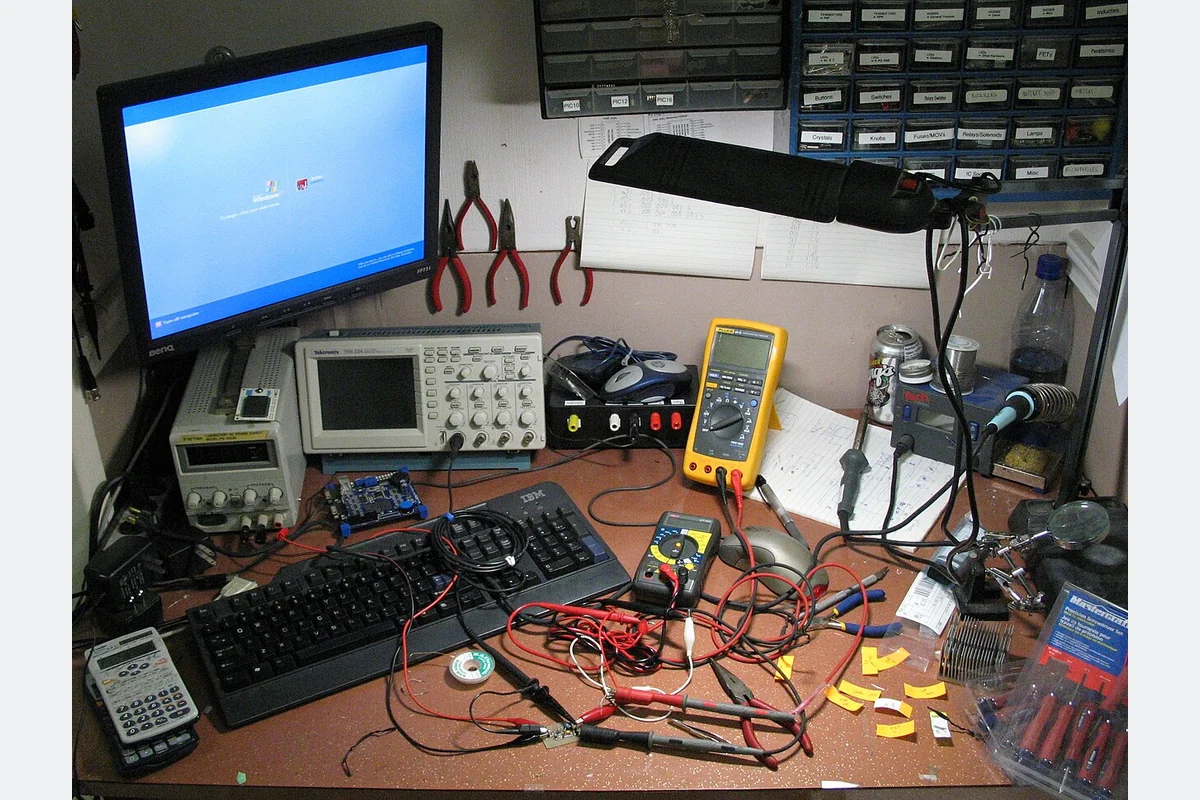
A real electronics workbench with component drawers, meters, probes and test instruments.Real photograph · illustrative context, not a Meter & Probe test.James Bastow / Wikimedia Commons · CC BY-SA 2.0 · resized and letterboxed for web
Sources and scope
Written from the references below and checked on 19 November 2026. Examples are illustrative calculations, not Meter & Probe hardware tests. Use the manual and data sheet for your exact equipment.
Use the free comparison tool to convert compatible units and assess the stated limits. For different instruments or ranges, calculate each accuracy interval separately and compare the measurement conditions.
No sign-up. No subscription. All eight tools are free to use.
Questions about investigating disagreement between meters
Why can one meter show 3.30 V and another show 3.32 V on the same source?
Each indication has its own range specification and measurement conditions. Input loading, timing and contact can also change the voltage being observed.
Should both meters be connected at once for a voltage comparison?
Simultaneous connection can change the load on a high-impedance source. Include both inputs in the circuit model rather than assuming the connection is neutral.
What does comparing overlapping instrument intervals actually establish?
It shows that the entered limits do not decisively separate the indications. It does not identify a true value or establish calibration of either meter.
Is the newer or more expensive meter automatically the correct reference?
Age and price do not establish reference status. A useful reference comparison needs documented performance, appropriate uncertainty and stated conditions.
Can mismatched probe contacts matter even on a stable bench supply?
Contact and measurement-location differences can change the observed voltage, especially with load current or poor connections. Record the exact points and conditions.
What should I check if separate meter intervals remain apart?
Review source stability, active range, function, connections and applicability of the specifications. A documented reference comparison may be needed to resolve the disagreement.
Which evidence should I include when asking which of two meters to trust?
Provide both models, ranges, specifications, indications, reference points and timing. Include relevant source and loading details rather than only two displayed numbers.
Should I swap the probe sets between meters to investigate a difference?
For a compatible, safe low-voltage setup, a controlled swap can help identify a lead or contact effect. Keep the source and connection points unchanged and record each arrangement.
Why does changing the ground test point alter the disagreement?
Return wiring can carry current and develop voltage drop. Two different reference points can represent different voltages even when both meters function correctly.
How do I compare a bench meter's ppm specification with a handheld meter's percentage?
Convert each complete formula to an absolute limit at its own reading and range. Include any range term; 100 ppm corresponds to 0.01%, but that may be only one contribution.
Its significance depends on the decision and both measurement limits. Relative difference alone does not establish which meter is wrong or whether either meets specification.
Can a low-battery warning explain a meter disagreement?
It can invalidate normal operating assumptions. Follow the battery instructions, repeat the controlled comparison and avoid assuming every discrepancy has that one cause.
Should I use the same range number on different meter models?
Not necessarily. Use suitable ranges for each and calculate their individual limits. Matching range labels does not guarantee equal resolution or input impedance.
Can I use the same-meter comparison tool for two different meters?
Not with one shared specification. Calculate each meter's interval separately; the same-meter tool cannot represent two different range-error models correctly.
What should I do before paying for recalibration over a small difference?
Check units, modes, ranges, contacts, source stability and battery warnings. If a meaningful discrepancy remains, a suitable reference or calibration service can investigate it.
These discussions helped identify practical questions. The answers and calculated examples here are our own; technical references are listed in the article. Forum replies can disagree and are not product tests or safety certification.