Battery behaviour

Why battery voltage drops under load and recovers afterwards

A battery that falls under load and recovers afterwards has not recharged itself. Separate the source's behaviour from losses in its holder, switch and wires, then compare the event with the device's limits.

Content reviewed · Examples are calculations, not tests of a supplied instrument.

In this guide · 7 sections

THE DIRECT ANSWER

When a battery delivers current, its terminal voltage can fall because of internal resistance and electrochemical effects. External contacts and leads add further loss before the device input. Voltage may recover after the demand ends without charge being added. The size of the drop depends on chemistry, temperature, state of charge, ageing and the current profile; it is not a universal battery-health percentage.

Estimate runtime from a stated current profile →
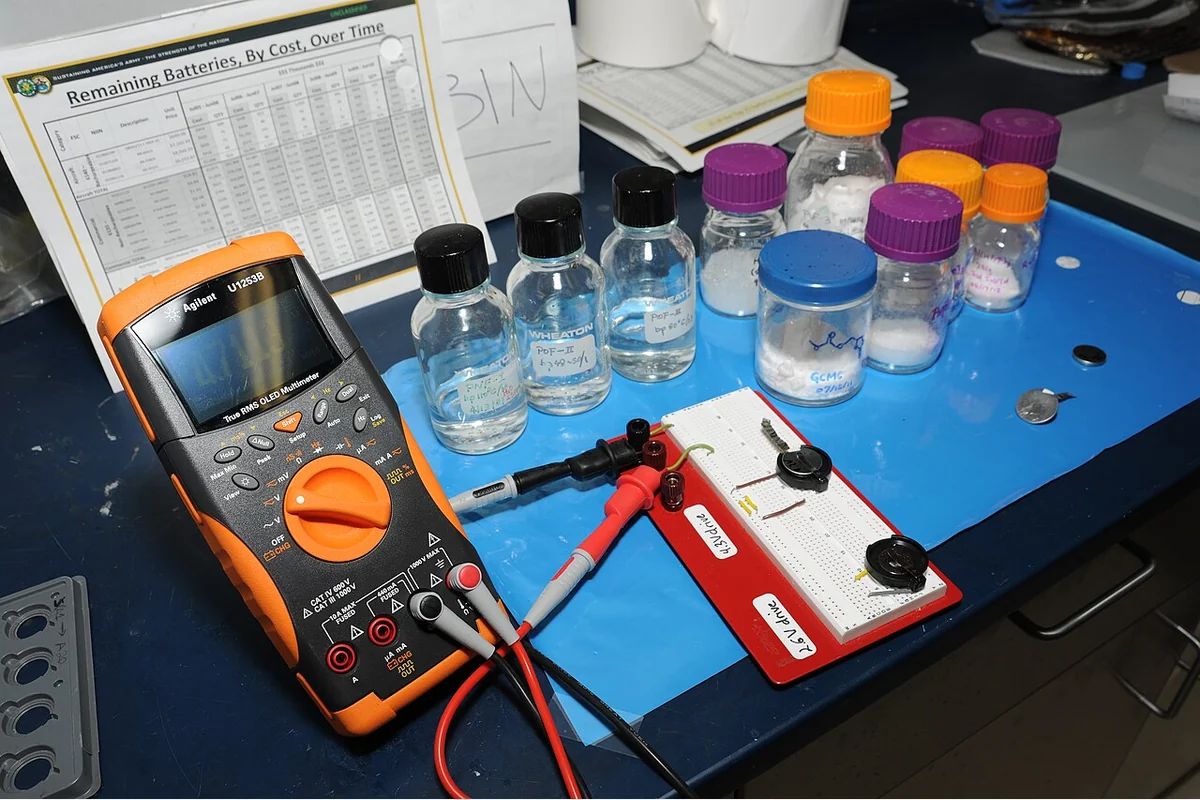
A digital multimeter, electrochemical test fixtures and labelled sample bottles on a battery-research laboratory bench.
A digital multimeter, electrochemical test fixtures and labelled sample bottles on a battery-research laboratory bench.Real photograph · illustrative context, not a Meter & Probe test. U.S. Army CCDC / Wikimedia Commons · CC BY-SA 2.0 · resized and letterboxed for web

A source model explains the first part of the drop

A simple battery model uses an ideal source in series with internal resistance. During discharge, terminal voltage is approximately the source voltage minus current multiplied by that resistance. OpenStax uses this model to explain why terminal voltage differs from electromotive force.

A real cell has time-dependent electrochemical behaviour as well. Its apparent resistance changes with the method, pulse duration, temperature, charge state and history. A brief pulse, a long discharge and an AC impedance test do not necessarily produce interchangeable values.

Use the battery maker’s specification and discharge curves for the identified chemistry and cell count. A familiar nominal voltage is not a guarantee of the loaded voltage window or the current that a particular cell can deliver.

A 0.15 V change at 0.10 A gives 1.5 Ω in the guide's simple ratio. That is an apparent value for that method and timing, not a permanent battery constant or a capacity measurement.

Measure at the battery and at the load

In an isolated low-voltage setup, compare voltage directly at the battery terminals with voltage at the device input under a repeatable operating state. A spring holder, protection board, switch, connector and both wires can add loss. A corroded contact can matter even if the cell is charged.

If the battery terminals stay near the expected loaded voltage but the device input falls, investigate the external path. If voltage already drops at the terminals, source behaviour or its internal protection may be involved. Neither pattern identifies a defective part without further evidence.

Keep the normal circuit arrangement documented. A USB lead can supply the device around the battery path, while a series ammeter can add burden voltage. Removing or inserting either changes the system being assessed.

A numerical example gives a scale, not a health score

Suppose a hypothetical rested cell reads 1.50 V. During a controlled steady 0.10 A load, its terminals read 1.35 V. The 0.15 V difference divided by 0.10 A is 1.5 Ω.

What the simple calculation includes
CalculationIllustrative resultLimit
Rest-to-load voltage change1.50 − 1.35 = 0.15 VDepends on rest state and measurement timing.
Change divided by load current0.15 ÷ 0.10 = 1.5 ΩAn apparent resistance for this method, not a universal cell constant.
Additional connector loss at 0.10 A0.05 V would imply 0.5 ΩOnly if the loaded boundary readings and linear approximation are valid.

This is not an instruction to apply a 0.10 A load to any battery. Use an approved method for the exact cell. The arithmetic cannot distinguish electrochemical polarisation from an ohmic contribution or predict usable capacity by itself.

Pulses and recovery can confuse a slow display

A sensor may spend most of its time asleep and draw a short larger current when its radio transmits. The battery voltage can dip during that event and recover before a meter display updates. Average current and the worst voltage dip are different design questions.

For a startup or reset fault, use a time-resolved method suitable for the circuit. Record the minimum, duration and operating event, then compare them with the device and regulator requirements. A minimum captured at an unrelated instant is not a complete explanation of a reset.

After load removal, recovery reflects the changed current and internal state. A voltage-based percentage gauge may rise even though no charger was attached. Do not count that recovery as newly stored energy.

Compare batteries under stated conditions

For a meaningful trend, keep battery identity, temperature, state of charge, rest interval, load profile and cutoff consistent. Use the manufacturer-supported test. An aged cell can show a plausible rested voltage while delivering less capacity or a larger drop, but a cold or partly discharged healthy cell can also sag.

For runtime, estimate representative average demand and usable capacity at the same supply boundary. For peak delivery, assess the voltage during the relevant current event. Passing one question does not automatically answer the other.

Do not use this guide to assess swollen, leaking, hot or damaged batteries, or to open a sealed pack. Follow the battery and equipment instructions. Record observations without turning a single terminal reading into an unsupported pass/fail health claim.

Common questions

Why does the voltage rise after I switch the device off?

The current-dependent drop reduces and the battery’s internal state relaxes. No charge needs to be added for its terminal voltage to recover.

Does more voltage sag always mean an old battery?

No. Chemistry, temperature, state of charge, load timing and contacts can also change the result. Compare under a defined supported test.

Can I calculate remaining mAh from the voltage drop?

Not from one drop alone. Capacity requires an appropriate battery model or a defined delivery test, including the endpoint and conditions.
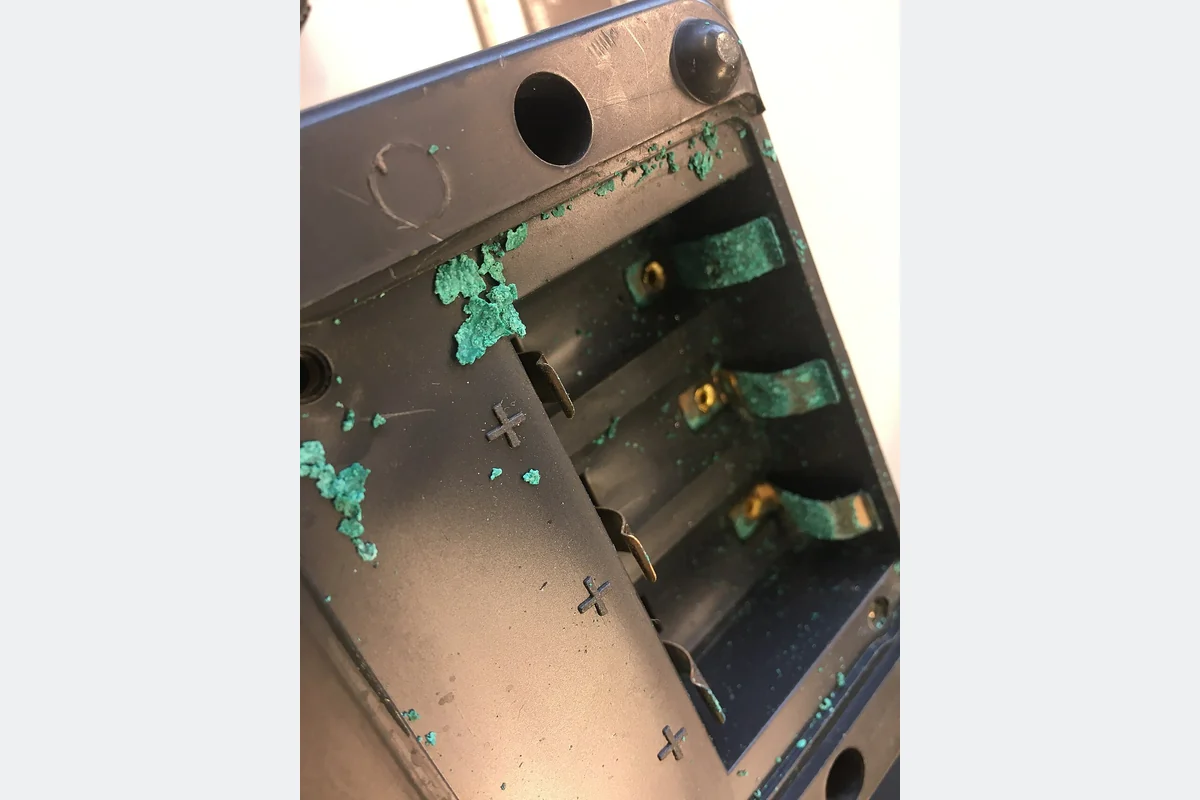
Close view of green corrosion on metal contacts inside a real battery holder.
Close view of green corrosion on metal contacts inside a real battery holder.Real photograph · illustrative context, not a Meter & Probe test. Gustamons / Wikimedia Commons · CC0 · resized and letterboxed for web

Sources and scope

Written from the references below and checked on 20 November 2026. Examples are illustrative calculations, not Meter & Probe hardware tests. Use the manual and data sheet for your exact equipment.

Our guides cover isolated low-voltage electronics. Read our methods and commercial disclosure.

Make the next check

Estimate runtime from a stated current profile using the conditions you recorded.

Open the matching tool →

Free online measurement tools

Free tools for a battery voltage drop under load

Use the free comparison calculator for repeatable voltage readings, then model current states in the battery-life tool. Keep temperature, rest time and load conditions with each observation.

No sign-up. No subscription. All eight tools are free to use.

Browse all free multimeter tools →

Practical questions

Questions about battery voltage sag and recovery

Why does a battery voltage fall while a device draws current?

Source behaviour and internal losses contribute to sag under load. Connection losses can add a further drop between the terminals and device.

Link to this answer
Why does the voltage recover after I disconnect the device?

Removing the load changes current and source conditions. Recovery is not evidence that the battery replenished the charge already used.

Link to this answer
How does the simple internal-resistance model explain voltage sag?

In that model, load current multiplied by resistance gives a drop from the source voltage. Real battery behaviour can also depend on time, chemistry and temperature.

Link to this answer
Can I treat one voltage-drop-over-current result as a universal battery resistance?

It is an estimate for the stated event and conditions. Battery dynamics, contacts and load changes can prevent that value from applying universally.

Link to this answer
How can I separate battery sag from a poor low-voltage connector?

Compare terminal and device-end voltage during comparable demand. The pattern helps locate whether the loss is at the source or along the connection path.

Link to this answer
Why can a radio burst cause more trouble than the average load suggests?

A brief higher-current demand can create a short dip. A steady display or average-current figure may not capture its amplitude and timing.

Link to this answer
Does greater voltage sag always prove that a battery is worn out?

Temperature, load level, charge state and connections also matter. Compare under stated equivalent conditions before making a health claim.

Link to this answer
Why might a cold battery behave differently under the same device load?

Battery performance and source behaviour depend on temperature. Record conditions and consult battery-specific information instead of attributing every change to capacity alone.

Link to this answer
Can voltage sag tell me exactly how many milliamp-hours remain?

No unique remaining-capacity value follows from one sag observation. Chemistry, history and load conditions need a suitable model or discharge evidence.

Link to this answer
What should I include when asking why a battery sags during startup?

Provide battery type, load event, source and device-end voltages, timing, temperature context and instrument response. That separates steady losses from brief events.

Link to this answer
Why does a NiMH pack voltage rise after I remove the load?

The current-dependent drop reduces and electrochemical conditions relax. Recovery can occur without a charger and does not mean the discharged charge returned.

Link to this answer
Is the initial voltage step the same as the slower voltage decline?

Not necessarily. A real battery has fast and slower responses. Their size depends on chemistry and timing, so one simple resistance does not explain the whole trace.

Link to this answer
Can a battery protection circuit cause a sudden device shutdown?

It can, depending on the pack and conditions. Use the pack documentation; do not bypass protection to continue a sag test.

Link to this answer
Why might one cell in a holder cause more trouble than the others?

Cell condition and contact paths can differ, but the pack total alone does not identify the cause. Follow the device's supported cell-check procedure.

Link to this answer
Does the voltage at the holder terminals include spring-contact loss?

It depends on the exact probe points. State whether you measured cell metal, holder output or device input before comparing the drops.

Link to this answer
Can a dirty battery spring produce the same symptom as high cell resistance?

It can add series loss and cause poor delivery. Compare appropriate endpoints under the same intended load before attributing the symptom to chemistry.

Link to this answer
Why can a fresh coin cell struggle with a radio burst?

Peak demand and source impedance can matter even when nominal capacity is adequate. Use the cell's permitted pulse characteristics and the device requirements.

Link to this answer
Will a larger mAh rating always mean less voltage sag?

No. Capacity and peak delivery are different characteristics. Chemistry, construction, temperature and operating state also affect the drop.

Link to this answer
How do I compare sag before and after a firmware change?

Keep battery state, temperature, connections and load timing comparable. Otherwise a changed event or source condition can be mistaken for a firmware effect.

Link to this answer
Can I use the meter's last displayed minimum as the whole brownout record?

Only within its capture limits, and the event duration still matters. A suitable time-resolved record is needed when a short dip triggers the fault.

Link to this answer
Why does voltage recover more slowly after a long load than a short pulse?

The battery's internal state depends on its recent demand. Time-dependent recovery is one reason pulse and long-discharge tests are not interchangeable.

Link to this answer
Does a 0.1 V drop tell me whether the device will reset?

Compare the actual device-input minimum and duration with its documented operating limits. The same drop can be harmless in one system and critical in another.

Link to this answer
Can I use an arbitrary resistor to test every battery's sag?

No. The load, power, pulse duration and endpoint must suit the exact battery and a supported test method. The numerical examples are not universal load instructions.

Link to this answer
What if the battery becomes hot, swollen or leaks during normal use?

Stop using it and follow the battery and device handling guidance. Do not continue a generic sag or capacity experiment on an abnormal battery.

Link to this answer
Why should a sag report include time since charging or discharging?

Recent history affects terminal voltage and relaxation. Comparing different rest states can make an unchanged battery appear to have a different drop.

Link to this answer
Public discussions behind these questions

These discussions helped identify practical questions. The answers and calculated examples here are our own; technical references are listed in the article. Forum replies can disagree and are not product tests or safety certification.

Questions also include related situations inferred from the article. They are not measured search-frequency data.