How to estimate battery life from sleep, wake and transmit current
A sensor that sleeps most of the minute can still spend most of its battery energy while awake. Estimate the time in each state before dividing capacity by a single current number.
Content reviewed · Examples are calculations, not tests of a supplied instrument.
Multiply each state current by its share of time, then add the contributions. Divide usable battery capacity in mAh by average battery-side current in mA to estimate hours. This is a planning calculation: capacity, supply conversion, temperature, self-discharge and missed bursts can change real runtime.
Put current and capacity on the same side of the supply
Choose a measurement boundary before collecting numbers. Battery capacity describes the battery. If you measure current after a regulator at a different voltage, you cannot simply divide the battery’s mAh figure by that rail current. Conversion efficiency and the regulator’s own current matter.
Prefer a representative battery-side current profile when it can be measured properly. If you instead use an energy model, record battery voltage, load voltage and conversion assumptions, recognising that voltage and efficiency can change through discharge. The simple calculator does not automatically make those conversions for you.
Use usable capacity under the intended load, temperature and device cutoff, rather than assuming that a label capacity is all available. A generic battery-voltage reading cannot supply that figure. For a design decision, test the intended battery and device over a suitable discharge cycle.
For the existing 54-second sleep and 6-second wake example, the time shares are 90% and 10%. A transmit burst must either be included in the measured wake-state average or listed separately, so its charge is not counted twice.
Build a cycle whose time shares add up to 100%
Choose a full cycle: for example, one sensor report interval. Include sleep, processing, sensor warm-up, transmission and any retries. Do not count the same seconds twice. If you group several activities into one “awake” state, its current needs to represent that whole period.
Convert times into shares by dividing each duration by the total cycle time. In a 60-second cycle, 54 seconds is 90% and 6 seconds is 10%. If the schedule varies, use a representative observation period and record that assumption.
Measure states with a method that captures them. A quiet multimeter display can be useful for steady sleep current but may not resolve a short transmit burst. Inserting a current meter can also change supply voltage, so confirm the device still behaves normally.
Worked example: 54 seconds asleep, 6 seconds awake
Illustrative 60-second current profile
State
Current
Duration
Time share
Average contribution
Sleep
0.10 mA
54 s
90%
0.10 × 0.90 = 0.09 mA
Awake
10 mA
6 s
10%
10 × 0.10 = 1.00 mA
Total
—
60 s
100%
1.09 mA
Assume 1000 mAh of usable capacity at that same measurement boundary:
1000 mAh ÷ 1.09 mA ≈ 917.4 hours ≈ 38.2 days
This is an idealised estimate from hypothetical inputs, not a promised battery life. In the tool, use sleep = 0.1 mA at 90%, wake = 10 mA at 10%, and transmit share = 0% when that third state is unused.
What changes if the awake period hides a transmit burst?
Suppose the same 60-second cycle actually contains 54 seconds at 0.10 mA, 5.4 seconds at 10 mA and 0.6 seconds at 100 mA. Those are 90%, 9% and 1%. The average becomes 0.09 + 0.90 + 1.00 = 1.99 mA.
With the same hypothetical 1000 mAh capacity, the ideal result is about 502.5 hours, or 20.9 days. The change comes from a missing operating state, not a different battery. It shows why a low sleep number alone can give a poor runtime prediction.
If the 10 mA value was already an accurately measured average of the whole awake period, do not add the burst again. Either use a representative aggregate or split the states consistently.
Turn the estimate into a useful design check
Change one assumption at a time: report interval, wake duration, retry rate or a measured peripheral load. Compare the resulting average currents before deciding which change is worth building. A tiny improvement in sleep current may have little effect if active work dominates.
Allow for capacity variation and behaviour near the device’s supply cutoff. There is no universal reserve percentage that makes every battery estimate reliable. Check whether the instrument captured startup, whether current rises as battery voltage falls, and whether a different environment changes the communication duty cycle.
Keep the raw state currents and durations alongside the result. A field trial can then be compared with specific assumptions rather than a single unexplained “days remaining” number.
Common questions
Can I use peak current to calculate battery life?
Peak current matters for source delivery, but multiplying it by the entire runtime usually overstates average demand. Include its duration and all other states, or measure representative total charge over time.
Can I use microamps in the calculator?
The current-profile fields use mA. Convert first: 100 µA is 0.1 mA. Keep capacity in mAh and all current values at the same supply boundary.
Why did the real battery last less than the estimate?
Possible reasons include less usable capacity, missed active events, regulator losses, self-discharge or a different environment. Check those assumptions and the device’s cutoff rather than treating the estimate as a guarantee.
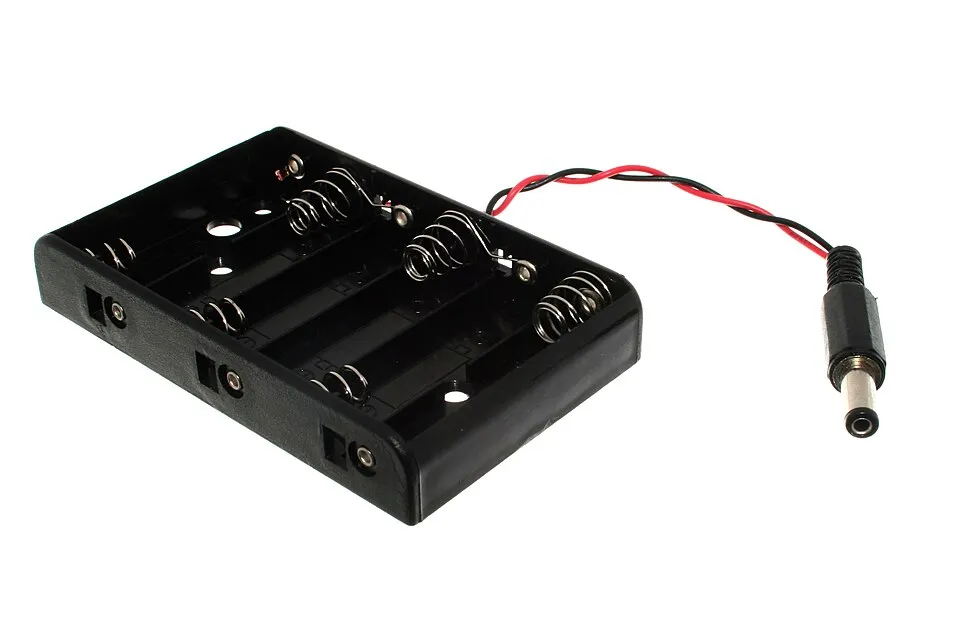
An example low-voltage battery holder. The photograph is not evidence of battery condition or a recommended pack for a particular board.oomlout / Wikimedia Commons · CC BY-SA 2.0 · resized for web
Sources and scope
Written from the references below and checked on 19 November 2026. Examples are illustrative calculations, not Meter & Probe hardware tests. Use the manual and data sheet for your exact equipment.
Free tools for battery runtime from a current profile
Use the free battery life calculator with currents and time shares for the same supply boundary. Estimate the series-meter voltage drop separately if the measurement could disturb the operating state.
No sign-up. No subscription. All eight tools are free to use.
Can a rare long radio retry matter to a battery-life estimate?
Yes. Its charge contribution can be significant despite low frequency. Include representative retries or assess separate scenarios instead of modelling only successful transmissions.
Why must battery capacity and measured current refer to the same supply side?
A converter changes voltage and current relationships. Dividing battery mAh by regulated-load current without accounting for conversion can give a misleading runtime.
Does an ideal runtime calculation include battery ageing and self-discharge?
The simple current-profile division does not model every battery effect. Treat usable capacity, self-discharge, ageing, temperature and cut-off as separate considerations.
Can averaging a few visible meter updates capture a complete device profile?
Only if the observations represent the relevant states and time behaviour. Short events or meter disturbance can make a few display updates unrepresentative.
What should accompany a claimed battery lifetime in a project description?
State usable capacity, supply boundary, state currents and durations, conversion assumptions and cut-off conditions. Identify the result as an estimate unless supported by a documented discharge test.
Do the state percentages need to total exactly 100%?
They must describe the complete cycle. Missing time leaves demand out; overlapping states can count it twice. Resolve the profile before trusting the runtime number.
What if I measured rail current after a boost converter?
Do not divide battery mAh by that current directly. Convert through a justified power and efficiency model or measure representative battery-side current.
How does doubling wake time affect average current?
It increases the active fraction and reduces other fractions if the cycle length stays fixed. Recalculate all shares rather than doubling the entire average blindly.
Why might a short laboratory profile overestimate months of field runtime?
It may omit retries, temperature changes, ageing or infrequent work. Include representative conditions and compare plausible profiles instead of extrapolating one quiet minute.
How do I compare a normal day with a poor-radio day?
Build two profiles with explicit event durations and currents, then calculate both. Keep the hardware and battery assumptions identical so the difference is interpretable.
Can the calculator measure the currents or validate my battery rating?
No. It combines the values you enter. Measurement quality, boundary consistency and usable-capacity evidence determine how much confidence the estimate deserves.
These discussions helped identify practical questions. The answers and calculated examples here are our own; technical references are listed in the article. Forum replies can disagree and are not product tests or safety certification.