How do I measure battery drain on a low-power device?
Model the current states first. A sleep current that looks excellent can be outweighed by short wake or transmit bursts, and the meter can disturb the state you are trying to observe.
What this can establish
State-weighted current
A first estimate of average current from the states you have named.
Runtime direction
An idealised capacity divided by average current, useful for comparing scenarios.
Missing evidence
Whether a short transmit burst, regulator loss or cut-off voltage needs separate attention.
What this cannot establish
Nominal battery capacity is not the same as usable capacity. A series ammeter can add burden voltage, wake a device, or hide a fast transient. A single sleep reading cannot prove the whole duty cycle.
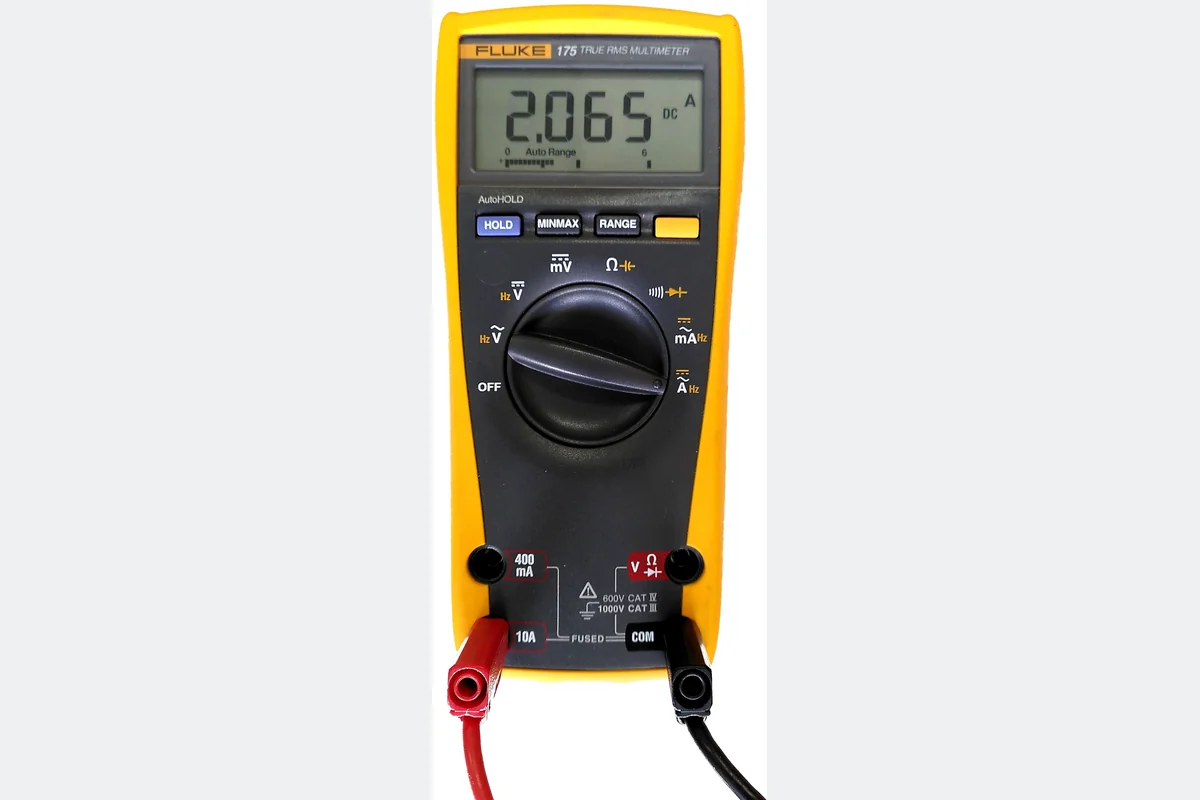
Real scene: keep the device in its state
Plan a repeatable sleep, wake and transmit sequence, then log the method, range, leads and supply condition. If the device changes state when the meter is inserted, use a suitable shunt and observe the voltage drop.
Illustrative Wikimedia Commons scene; not a Meter & Probe test.
Next measurement
Compare the same state with a shunt or an appropriately rated clamp. Record the supply voltage at the device, not only at the bench supply, and keep burst timing with the current trace.
Why is my ESP32 deep sleep current higher than the datasheet?
How do I measure ESP32 sleep current with a multimeter?
How do I measure standby current without waking the circuit?
How do I measure battery drain on a low-power device?
Can a multimeter measure microamps accurately?
How do I compare sleep, wake and transmit current?
How do I calculate battery runtime from measured current?
How do I estimate battery life from average current?
Multiply each state’s current by the fraction of time in that state, then add the results. Divide usable battery capacity in mAh by the time-weighted average current in mA to estimate hours.
Worked example: A project that draws 0.1 mA for 90% of the time and 10 mA for 10% averages 1.09 mA. With 1,000 mAh of usable capacity, the ideal estimate is about 917 hours.
Assumptions and limits: This is an estimate based on repeatable state timing and usable capacity. Current spikes, regulator losses, temperature and cut-off voltage can shorten actual runtime.
My board draws 0.00 mA in sleep. Does that mean it uses no battery power?
It may be below the visible step or missing brief wake events. Check the range, zero and sample timing before treating the display as zero consumption.
My battery monitor reports once a second. Could it miss wake-up spikes?
It depends on how the monitor samples and averages between reports. Compare the pulse duration with the capture window and log peaks separately from average current.
My car battery goes flat after two days parked. How do I distinguish drain from a tired battery?
Open-circuit voltage alone does not identify the cause. Check the vehicle handbook or ask a technician to assess battery condition, charging and model-specific sleep behaviour.
Is 45 mA after locking my car normal, or has it not gone to sleep?
There is no universal threshold or wait time. Compare the reading and elapsed time with the vehicle’s documented sleep procedure or a technician’s assessment.
Record the instrument, connections and operating state alongside the number.
Use current values from one defined supply boundary and verify the device still behaves normally.Real photograph · illustrative context, not a Meter & Probe test.Christiankral / Wikimedia Commons · CC BY 4.0 · resized and letterboxed for web
Free online measurement tools
Free battery life calculator
Estimate average current and ideal battery runtime from sleep, wake and transmit states. Use this free online measurement tool without creating an account. The worked example and limits on this page explain how to read the result.
No sign-up. No subscription. All eight tools are free to use.
What current do I enter for a sensor that sleeps for 54 seconds out of 60?
The sleep share is 90% and the remaining six seconds are 10%. Enter measured state currents; separate transmission if it is a distinct part of that cycle.
Which battery capacity should I use when the device cuts off early?
Use an estimate of capacity available under the actual load, temperature and cut-off conditions. A label capacity may describe different discharge conditions.
Can I enter regulated 5 V load current with a 3.7 V battery mAh rating?
Those values belong to different supply boundaries. Account for voltage conversion and losses first, or use a current profile measured on the battery side.
Does a zero-current input imply infinite real battery life?
A zero weighted current does not support a discharge runtime estimate. Real systems also have self-discharge and other losses outside this simple model.