
THE DIRECT ANSWER
A single voltage reading cannot give a universal battery percentage. Voltage-based state-of-charge estimates need the correct chemistry, cell count, manufacturer relationship and measurement conditions. Load, recent charging or discharge, rest time and temperature all affect the result. Remaining charge is also different from remaining usable capacity or battery health.
Build a runtime estimate from stated capacity and current →

Identify the battery before interpreting its voltage
Start with the exact battery or pack specification: chemistry, series cell count, nominal voltage, charging method and permitted operating limits. Similar-looking cells can have different voltage behaviour. A pack-level reading cannot reveal the voltage of every internal cell.
Use the maker’s discharge curves or state-of-charge guidance where available. A voltage-to-percentage tool can be convenient, but check which battery type and conditions it assumes. Do not apply a generic lithium-ion table to LiFePO4, NiMH, alkaline or an unidentified pack.
The issue is not solved by adding decimal places. A precise reading of an unsuitable proxy can still produce a poor percentage estimate. Keep the meter accuracy question separate from the battery model used to interpret the reading.
The NiMH discussion linked below asks why voltage rises after discharge and disconnection. The recovery is real, but it does not mean charge was added. A percentage inferred from voltage can rise while stored charge has not increased.
Open-circuit and loaded voltage describe different conditions
A battery supplying current can show a lower terminal voltage than it does with the load removed. Internal resistance, electrochemical behaviour and the current profile contribute to that change. A brief burst can cause a dip that a slow display does not capture.
After load removal, the voltage can recover without new charge being added. Recent charging can also affect the reading. If a manufacturer’s relationship expects an adequately rested open-circuit voltage at a stated temperature, a reading during transmission or just after charging does not meet those conditions.
There is no single rest time appropriate to every chemistry and test objective. Follow the specific battery guidance and record elapsed time, temperature and whether any monitoring or protection circuit remains connected. “Disconnected from the device” does not necessarily mean zero load inside a pack.
Charge, capacity and health are separate questions
| Question | What it concerns | Why one voltage is insufficient |
|---|---|---|
| State of charge | How much charge remains relative to the battery’s present full-charge state. | The voltage relationship depends on chemistry, conditions and its discharge curve. |
| Usable capacity | Charge or energy deliverable before the device or test reaches its cutoff. | Load, temperature, ageing and the permitted voltage window matter. |
| State of health | Performance compared with an appropriate new or specified reference. | A charged aged battery can show a plausible voltage but store less usable energy. |
| Remaining runtime | Time before this device stops under a particular operating profile. | Both usable energy and future demand are needed. |
A battery may reach a familiar full-charge voltage yet deliver less runtime than it once did. Conversely, a loaded voltage dip may reflect an active event rather than a sudden loss of the same fraction of stored charge. Do not label either observation as a measured health percentage.
Make the voltage reading useful without overclaiming it
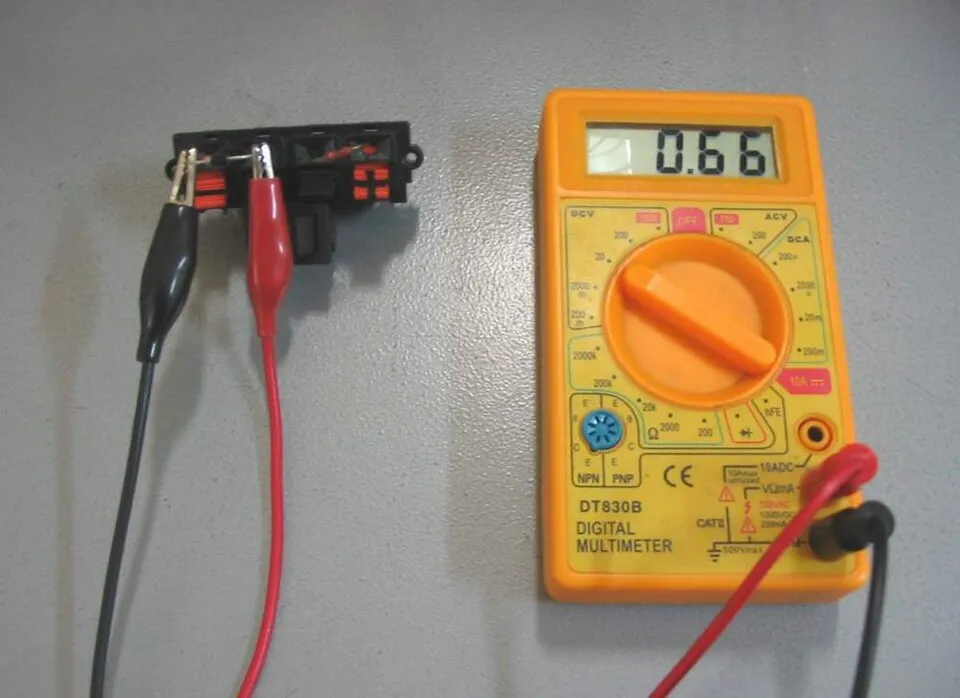
For a suitable isolated low-voltage battery setup, use the voltage function and input sockets specified in the meter manual. Check that both the battery and instrument are within the intended conditions. Never put a current input directly across a battery, and do not open a sealed pack to obtain extra readings.
Record the battery identification, terminal voltage, load state, recent charge or discharge, rest interval, temperature and device behaviour. Compare readings made under the same conditions. If the aim is to investigate a shutdown, capture the relevant operating event rather than relying only on a rested reading afterwards.
Use battery and equipment instructions for damaged, swollen, leaking, hot or otherwise abnormal batteries. The voltage number is not a safety or charging decision on its own. This guide is not for EV, traction or other high-energy packs.
Choose a method that answers the actual question
For an approximate charge estimate, use a validated relationship for the identified battery and report its assumptions. Some systems use charge counting, voltage, temperature and a battery model together. Charge counting also needs an initial reference, loss assumptions and a way to account for capacity change.
For remaining runtime, combine appropriate usable capacity or energy with a representative demand profile. Our current-profile calculator can compare sleep, wake and transmit assumptions at one supply boundary; it cannot derive usable capacity from an entered terminal voltage.
For health or capacity, use a suitable manufacturer-supported test that measures delivery under defined conditions. Keep the endpoint and load with the result. Avoid turning an attractive voltage chart into a certainty that the underlying battery data cannot support.
Common questions
Why does the battery percentage rise after I remove the load?
Terminal voltage can recover after a load is removed. A voltage-based gauge may interpret that recovery as a higher charge estimate, even though no charging occurred.
Does full voltage prove the battery is healthy?
No. A battery can reach a plausible charged voltage while having reduced usable capacity or poor delivery under load. Health needs an appropriate performance comparison.
Why does this site not offer one universal voltage percentage table?
A single table would conceal chemistry, cell count and measurement assumptions. Use the identified battery’s guidance and describe the conditions instead of presenting an unsupported universal percentage.

Sources and scope
Written from the references below and checked on 19 November 2026. Examples are illustrative calculations, not Meter & Probe hardware tests. Use the manual and data sheet for your exact equipment.
- Battery University — BU-903: How to Measure State-of-charge; chemistry, rest conditions and charge counting
- AllMultimeterGuide — Battery Voltage Checker; comparison reference for common voltage questions
- OpenStax — Electric Power and Energy; P = IV and energy over time
- iFixit — How to Use a Multimeter; selecting functions and making basic connections
Our guides cover isolated low-voltage electronics. Read our methods and commercial disclosure.
Make the next check
Build a runtime estimate from stated capacity and current using the conditions you recorded.
Open the matching tool →