The battery has voltage, but the device will not start: what to check
A battery reads 3.10 V with the device idle, yet the device will not boot. The next useful observation is the voltage at the device during its normal startup attempt, not another unloaded reading.
Content reviewed · Examples are calculations, not tests of a supplied instrument.
A no-load voltage reading does not show whether a source can supply the required startup current. Compare voltage at the source and at the device during the same repeatable operating state. A drop can come from the source, contacts, wiring or the measurement setup; a steady voltage does not rule out a control or device fault.
Record the battery chemistry, pack arrangement, device supply rating and any regulator between them. The printed voltage is a nominal description, not a universal full/empty threshold. A coin cell, alkaline AA pack and rechargeable lithium pack behave differently under load.
Keep this check to an intact, isolated low-voltage device and its intended power source. Stop using a damaged, leaking or swollen battery. Do not improvise a discharge load, bypass battery protection or open a mains-powered supply to follow this guide.
Put the meter in the appropriate DC voltage function with the leads in COM and the specified voltage socket. A current input is not used across the battery. The device’s own normal startup attempt provides the load for the comparisons below.
In the guide's example, the source falls to 2.55 V and the device input to 2.30 V. That separates source sag from another 0.25 V lost along the connection path. Neither number alone identifies a failed component.
Compare three observations
Useful observations for a device that will not start
Observation
What it can tell you
What it cannot prove
Source voltage before startup
There is a potential difference at those probe points with the present load.
Remaining capacity, battery health or ability to supply a current pulse.
Source voltage during a repeatable startup attempt
A visible sustained drop points towards limited source delivery or a large load.
The cause of a fast event that the meter did not capture.
Device-input voltage during the same operating state
A lower reading than at the source can expose a voltage loss along the path.
A specific connector is faulty without measuring across that part of the path.
Use the device’s proper local return point. Different ground points can include a return-path voltage drop. If you take readings one after another, repeat the same startup action and note that the events may differ. A one-off comparison of unrelated moments is weaker evidence.
Example: plausible open voltage, poor delivery
Imagine an intended 3 V battery device. Before startup the source reads 3.10 V. During a sustained startup attempt it reads 2.55 V, while the device input reads 2.30 V under a comparable condition. These illustrative values show two effects: a 0.55 V drop at the source and a further 0.25 V lost along the supply and return path.
Whether 2.30 V is too low depends on that device’s documented input limits. The numbers do not identify battery chemistry, prove a short circuit or give a remaining-charge percentage. Check the source capability and the connection path separately.
With the source off and any stored energy dealt with, inspect the accessible low-voltage connector, switch and battery contacts. A continuity beep on an unpowered lead only shows the meter’s low-current test condition. A contact can pass that test and still drop voltage under the device’s normal load.
What if the meter keeps showing the right voltage?
A digital display updates over time. A brief startup dip may be too short to appear, or a capture/minimum feature may have a response time that misses it. Look up the actual capture specification; the word “MIN” is not a guarantee for every pulse.
For a transient question, use suitable time-resolved equipment and an appropriate low-voltage connection method. If the supply is steady within the device’s limits, check its documented enable pin, switch state, reset indication, firmware status and expected startup sequence. Good supply voltage is necessary for many devices, but it is not a complete functional test.
A high-resistance signal can also display a voltage while providing little current. Read the input-loading guide before interpreting a reading on a sensor output or an unexplained floating node as a usable power rail.
Do not let the meter create a new symptom
If the device starts normally without an ammeter but fails when one is inserted, investigate the meter’s burden voltage and the wiring change. This is a separate observation from a device that never starts. Switch power off before rewiring; never bridge the source with current-mode probes.
Keep a note of source voltage, device-input voltage, device state, range and timing. Enter an unexpected OL, zero or unstable display in the reading checker. If you need to estimate runtime after the startup fault is resolved, measure the operating profile rather than inferring capacity from this single voltage check.
Common questions
Does the labelled battery voltage mean the battery is good?
No. The label is nominal, and a no-load reading does not establish capacity or startup-current delivery. Use the battery and device specifications and observe the intended load.
Can a continuity beep prove a cable is good under load?
No. The continuity test uses the meter’s own small test current and threshold. A poor contact can behave differently at the device’s operating current.
Can I calculate exact charge percentage from voltage?
Not from a generic reading. Chemistry, temperature, load, rest time and the battery’s discharge curve matter. Use a method validated for the specific battery and application.
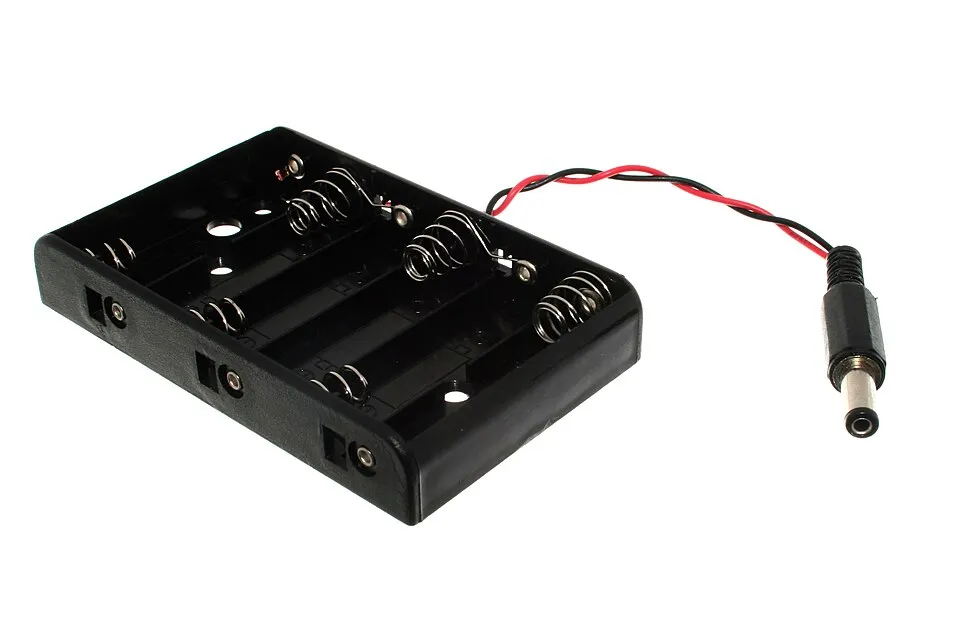
An example low-voltage battery holder. The photograph is not evidence of battery condition or a recommended pack for a particular board.oomlout / Wikimedia Commons · CC BY-SA 2.0 · resized for web
Sources and scope
Written from the references below and checked on 19 November 2026. Examples are illustrative calculations, not Meter & Probe hardware tests. Use the manual and data sheet for your exact equipment.
Free tools for a device that has voltage but will not start
Use the free reading troubleshooter to plan the next low-voltage check. Compare a repeatable loaded reading with an unloaded one, keeping the circuit state and reference point in the record.
No sign-up. No subscription. All eight tools are free to use.
Questions about a battery device that will not start
Why does a battery-powered board fail to boot despite a plausible voltage?
The unloaded source value may not describe voltage at the device during startup. Source sag, connection loss and brief events need different observations.
Can a damaged battery connector pass a simple no-load voltage check?
A voltmeter draws little current. A poor connection can show plausible voltage unloaded while losing more voltage under the device’s operating current.
Which follow-up is more informative than immediately replacing the meter?
Define the failing operating event and compare source and device voltage under that condition. Choose the next instrument according to the unresolved time behaviour.
Could a battery be fully charged and still fail to supply startup current?
Yes. Charge state, internal impedance and condition are separate issues. Compare voltage during the device's intended startup event with its input requirements.
Why does a device briefly flash an LED and then switch off?
A supply dip, protection action or device fault can produce that symptom. Record the supply behaviour and documented startup indicators rather than diagnosing from the flash alone.
How does a bad switch differ from a weak battery in the measurements?
A loss across the connection path with the battery terminals holding steadier points toward that path. Reproduce the same load state before comparing locations.
Should I keep pressing the power button to get a useful reading?
Use the device's normal procedure. Repeated attempts can change load, temperature or protection state, so record the sequence rather than combining unrelated events.
Can reversed polarity explain voltage present but no operation?
It can. Confirm the intended connector polarity from reliable documentation with an appropriate voltage measurement; do not test by reversing the supply experimentally.
What if the supply voltage is steady and within the device limits?
Move to documented enable, reset, switch and firmware checks. A good supply reading is one requirement, not proof that the complete device must operate.
No. Connector loss, regulator behaviour, protection and device faults can remain. Establish the limiting part of the power path before choosing a replacement.
Should I connect an ammeter across the battery to check its strength?
No. A current input across a source can short it. Follow a suitable supported test method; this guide uses the device's normal load for voltage observations.
What details should I send with a “won't boot on battery” question?
Include the exact board, intended source, wiring path, source and device voltages during the same event, and whether USB or a debugger remains connected.
These discussions helped identify practical questions. The answers and calculated examples here are our own; technical references are listed in the article. Forum replies can disagree and are not product tests or safety certification.